
Compression bonded magnets offer significant sustainability advantages in automotive manufacturing. Their lower-energy production process generates minimal waste, and sourcing them domestically reduces transportation emissions and enhances supply chain stability, making them a greener, more resilient choice that can also improve vehicle efficiency and performance through lightweight design.
What You'll Learn
This article breaks down the key factors that make compression bonded magnets a superior sustainable option for the automotive industry. Here's a quick overview:
- The Eco-Friendly Manufacturing Process: Discover how lower energy consumption and minimal material waste set these magnets apart.
- Supply Chain Sustainability: Understand how a domestic supply chain reduces carbon footprint and increases operational resilience.
- Key Automotive Applications: See exactly where compression bonded magnets are used to improve vehicle efficiency and performance.
- A Clear Comparison: Learn how they stack up against other permanent magnet types from a sustainability perspective.
The Core of Sustainability: An Efficient Manufacturing Process
The environmental impact of any component begins with how it's made. The unique manufacturing method of Compression Bonded Magnets is inherently more sustainable than traditional alternatives.
Lower Energy Consumption
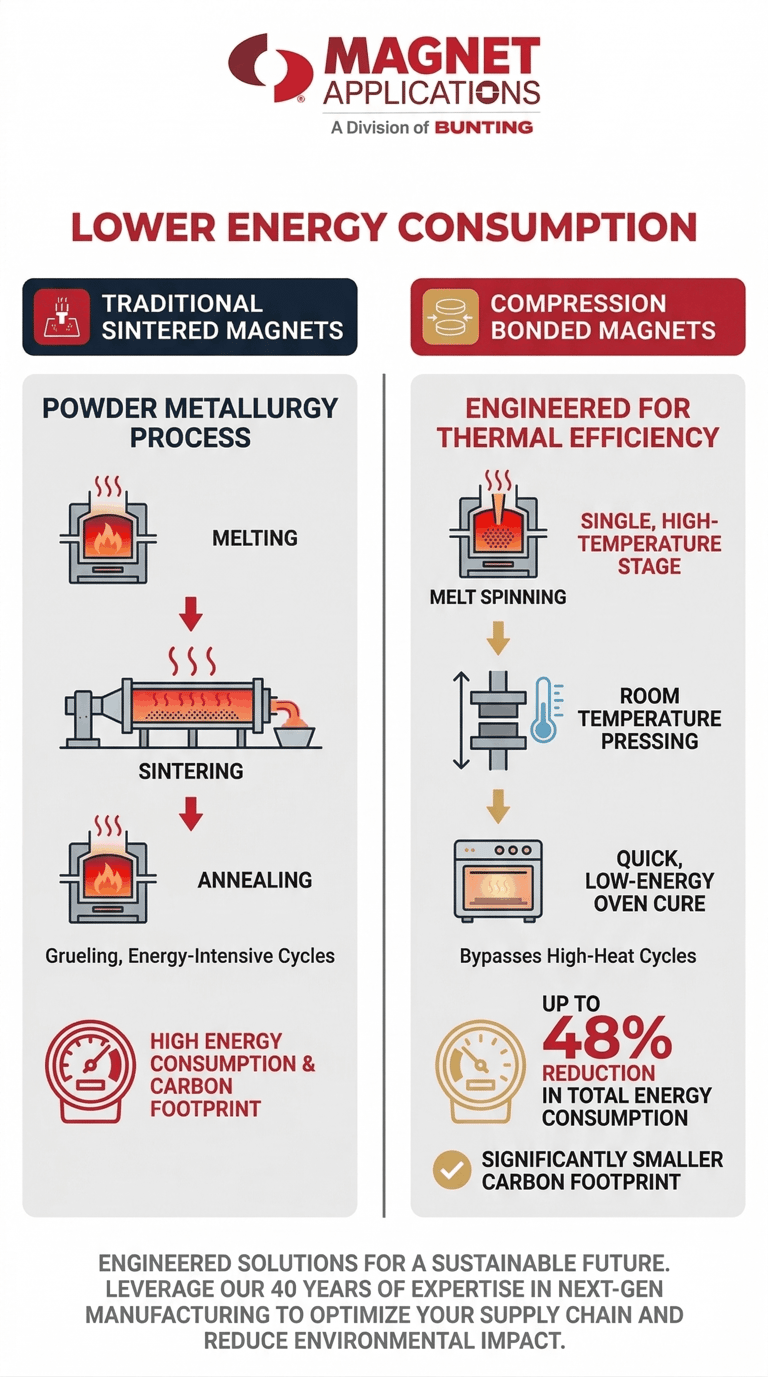
While the production of any high-performance magnet requires heat, compression bonded magnets are engineered for thermal efficiency. The process begins with melt spinning to create the magnetic powder—a single, high-temperature stage that ensures peak performance. However, this is where the heavy heating ends.
In contrast, traditional sintered magnets rely on "powder metallurgy," a grueling process involving multiple, prolonged high-heat stages including melting, sintering, and annealing. Compression bonded magnets bypass these energy-intensive cycles. Instead, the nanocrystalline powder is mixed with a resin binder and pressed into a mold at room temperature, followed by a quick, low-energy oven cure. By consolidating the high-heat requirements into a single step, this process can reduce total energy consumption by up to 48%, directly translating to a significantly smaller carbon footprint for every part produced.
Minimal Material Waste
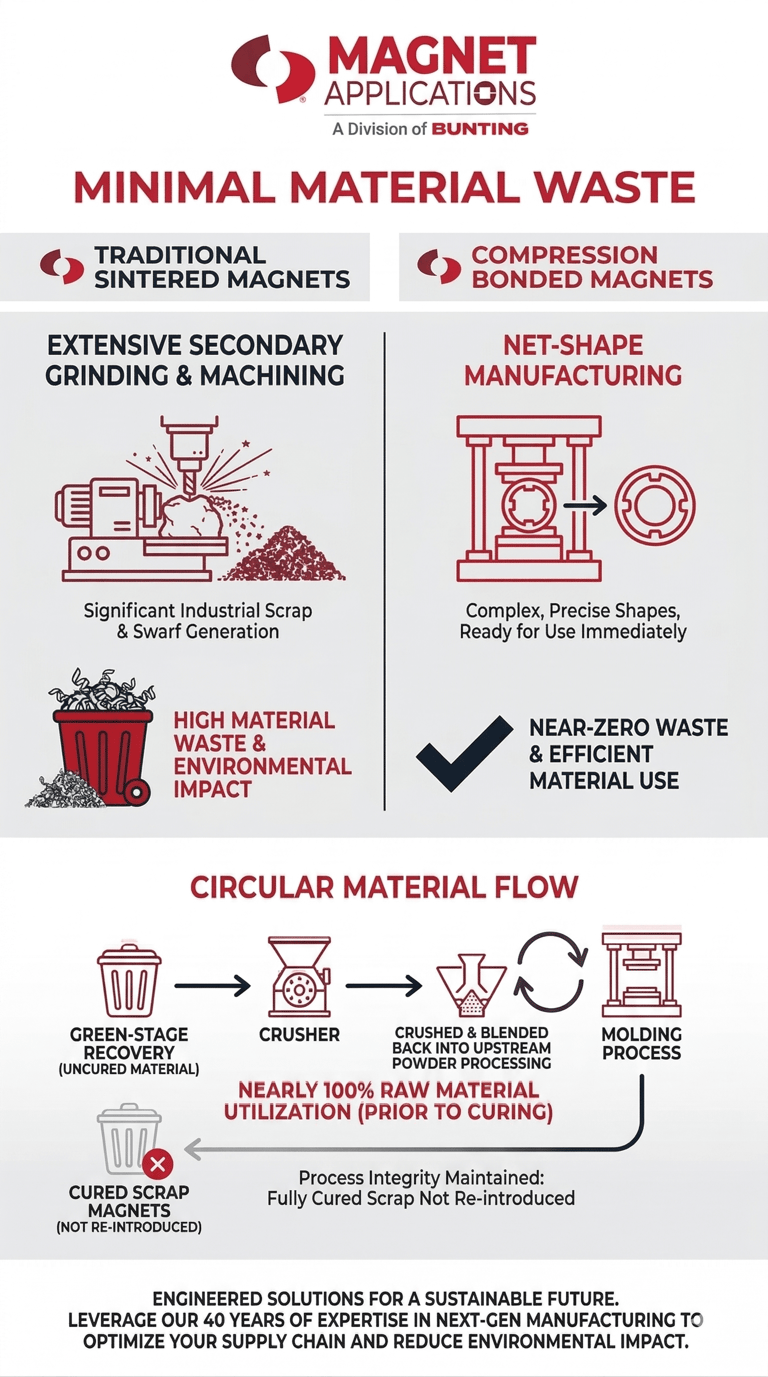
One of the most compelling sustainability features of compression bonded magnets is "net-shape" manufacturing. Unlike sintered magnets, which often require extensive secondary grinding or machining to reach their final dimensions, bonded magnets are pressed into complex, precise shapes—including intricate thin-walled geometries—that are ready for use immediately.
This process inherently conserves valuable rare-earth materials by avoiding the industrial scrap and "swarf" (fine metal debris) typically generated during traditional machining. Beyond the initial molding efficiency, the production line itself supports a circular material flow:
- Green-Stage Recovery: During the production process, "green" (uncured) material that does not meet initial pressing specifications can be crushed and seamlessly blended back into the upstream powder processing.
- Material Conservation: This internal recycling loop occurs prior to resin curing, ensuring that nearly every gram of raw magnetic powder is utilized in a finished component rather than being discarded.
- Process Integrity: It is important to note that while green-stage material is recovered, fully cured scrap magnets are not routinely re-introduced into the same high-precision process. This distinction ensures that the mechanical and magnetic integrity of the final product remains uncompromised.
By producing parts to their final dimensions from the start and capturing material before it reaches the waste stream, manufacturers significantly reduce their environmental footprint while protecting the stability of their rare-earth supply.
Supply Chain Sustainability: The Domestic Advantage
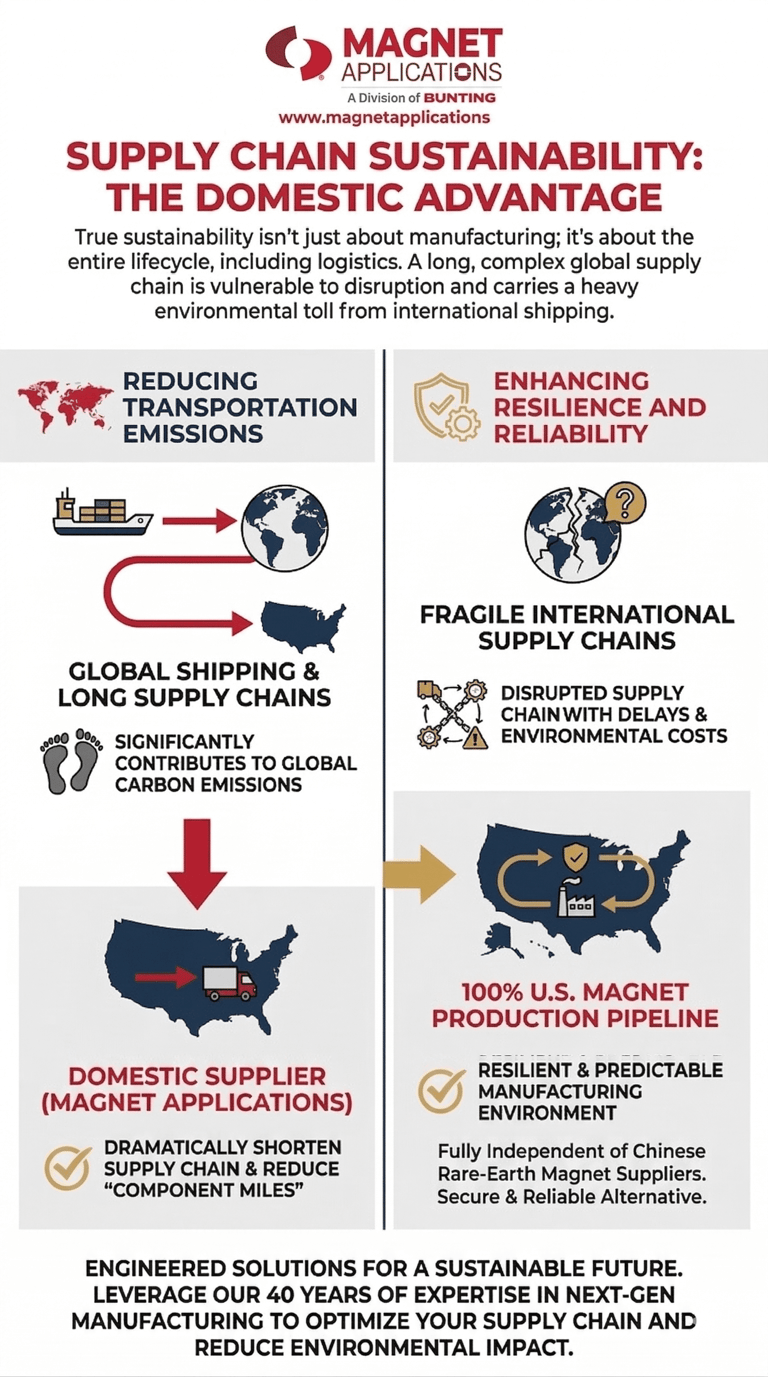
True sustainability isn't just about manufacturing; it's about the entire lifecycle, including logistics. A long, complex global supply chain is vulnerable to disruption and carries a heavy environmental toll from international shipping.
Reducing Transportation Emissions
Sourcing components from overseas contributes significantly to global carbon emissions. By utilizing a domestic supplier like Magnet Applications, which operates a 100% U.S. magnet production pipeline, automotive manufacturers can dramatically shorten their supply chain. This reduction in "component miles" is a tangible step toward greener operations.
Enhancing Resilience and Reliability
Recent global events have shown the fragility of international supply chains. A domestic source for critical components like Compression Bonded Magnets creates a more resilient and predictable manufacturing environment. This stability is a key pillar of sustainable business operations, ensuring production can continue without the delays and environmental costs associated with geopolitical disruptions. Magnet Applications is fully independent of Chinese rare-earth magnet suppliers, offering a secure and reliable alternative.
Sustainable Performance: Key Applications in Modern Vehicles
Compression Bonded Magnets are perfectly suited for numerous systems within a vehicle where efficiency, precision, and complex design are critical. Their isotropic nature allows them to be magnetized in any direction, enabling custom multi-pole configurations that are ideal for compact and efficient designs.
- Electric Motors for Comfort and Convenience: These magnets are the driving force in many fractional horsepower motors. Their excellent shape flexibility makes them ideal for the intricate and space-constrained motors that power seats, windows, sunroofs, and automatic liftgates.
- Advanced Sensors and Encoders: Modern vehicles rely on hundreds of sensors for everything from engine timing to stability control. The precise magnetic fields and complex shapes achievable with Compression Bonded Magnets make them essential for rotary encoders and motion sensors that ensure vehicle systems operate with maximum efficiency.
- Efficient Pumps and Fans: Auxiliary systems like fuel pumps, water pumps, and cooling fans all benefit from the reliable and cost-effective performance of these magnets. Efficient operation in these systems contributes to the overall fuel economy and reduced emissions of the vehicle.
Comparing the Alternatives: A Quick Sustainability Snapshot
When evaluating options, it's clear why Compression Bonded Magnets stand out.
- Compression Bonded Magnets: Lower-energy production, minimal waste due to net-shape manufacturing, and the option for a secure, low-emission domestic supply chain.
- Sintered Neodymium Magnets: Extremely high-energy production process, significant material waste from post-production grinding, and heavy reliance on fragile global supply chains.
- Injection Molded Magnets: Offer high shape flexibility but have lower magnetic strength, which can lead to less efficient motor designs for certain power-intensive applications.
The Clear Choice for Sustainable Automotive Design
For automotive manufacturers committed to sustainability, Compression Bonded Magnets are not just a component—they are a strategic choice. They deliver on multiple fronts: an eco-friendly manufacturing process, a more resilient and lower-carbon supply chain, and the precise performance needed for efficient modern vehicles.
By integrating these advanced magnetic solutions from a proven domestic supplier, automakers can build vehicles that are not only technologically superior but also demonstrably better for the planet.