
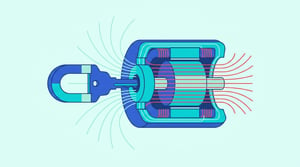
Innovative design strategies for electric motors involve using injection molded magnets for complex geometries, integrating components directly into and/or around the magnet, and creating intricate multi-pole patterns. This enables the design of smaller, lighter, more efficient, and cost-effective motors for a new generation of applications.
What You'll Learn
This article breaks down the cutting-edge design strategies that are transforming electric motor development. Here's a summary of what we'll cover:
- Radical Miniaturization: How to design smaller and lighter motors without sacrificing performance.
- Integrated Component Design: A strategy to simplify assembly, reduce part counts, and increase reliability by molding magnets around or into other components.
- Advanced Multi-Pole Magnetization: Techniques for creating complex magnetic fields in a single part to improve motor smoothness and efficiency.
- Optimized Magnetic Flux Paths: How to use custom shapes to direct magnetic energy precisely, boosting torque and minimizing waste.
1. Radical Miniaturization and Weight Reduction
In industries from automotive to aerospace, the demand for smaller, lighter components is relentless. Traditional sintered magnets, be they, Ferrite, Alnico or Neodymium (NdFeB) are dense and limited to simple shapes, making miniaturization a significant challenge. The goal is to shrink the motor's footprint while maintaining its power output.
How Injection Molded Magnets Enable This
Injection molded magnets are a composite of magnetic powders and a lightweight polymer binder like nylon. This composition immediately offers a strategic advantage:
- Lower Density: The polymer binder significantly reduces the magnet's overall weight compared to fully dense sintered magnets. In automotive applications, this weight reduction contributes directly to better fuel efficiency or extended battery range.
- Shape Optimization: Because they are molded, these magnets can be formed into thin-walled, complex, or hollow shapes that fit perfectly within compact assemblies, eliminating wasted space and material.
2. Integrated Component Design: Simplifying Assembly
A traditional motor rotor often involves assembling a magnet, a hub, a shaft, and other components, each with its own manufacturing tolerances. This multi-part assembly adds complexity, cost, and potential points of failure. An innovative approach is to consolidate these parts into a single, unified component.
How Injection Molded Magnets Enable This
The injection molding process is uniquely suited for component integration, often called "insert molding" or "overmolding."
- One-Step Assembly: A motor shaft, hub, or other structural part can be placed directly into the mold. The magnetic material mix is then injected around it, creating a single, robust component where the magnet is perfectly bonded to its supporting structure.
- Improved Tolerances: This process eliminates tolerance stacking from multiple parts. The resulting precision is exceptional, ensuring a consistent and reliable magnet-to-armature gap, which is crucial for performance.
3. Advanced Multi-Pole Magnetization
Motor performance, especially in brushless DC (BLDC) motors, depends on the precise arrangement of north and south magnetic poles on the rotor. Creating complex pole patterns with traditional magnets often requires assembling multiple, precisely cut magnet segments—a costly and labor-intensive process.
How Injection Molded Magnets Enable This
Injection molded magnets excel at creating sophisticated magnetic patterns on a single, monolithic part.
- Complex Geometries: The molding process can produce magnets with intricate surface features designed to work with complex magnetizing fixtures.
- Multi-Pole Magnetization: As these are Isotropic (meaning they have no preferred direction of magnetism) materials, they can later be magnetized into any shape or direction. A single, solid injection molded rotor can be magnetized with multiple poles (e.g., 8, 12, or more) as well as skewed in a single step post-molding. This allows for smoother motor operation, higher precision in sensor applications, and simplified designs.
4. Optimized Magnetic Flux Paths for Peak Efficiency
The efficiency of an electric motor is determined by how effectively it converts electrical energy into mechanical motion. A key factor is controlling the "magnetic flux"—the path the magnetic field takes. Wasted or leaking flux reduces torque and generates waste heat. The ideal strategy is to shape the magnet to direct this flux precisely where it's needed.
How Injection Molded Magnets Enable This
The design freedom of injection molding allows engineers to move beyond simple blocks and arcs and create magnets that function as perfect magnetic circuit components.
- High Shape Flexibility: Injection molded magnets can be designed with curved, tapered, and asymmetric profiles that conform perfectly to the motor's stator or armature.
- Precision and Tight Tolerances: This ability to create complex shapes with high precision allows for minimal air gaps between the rotor and stator, maximizing magnetic field interaction and significantly boosting motor torque and efficiency.
Key Advantages of Designing with Injection Molded Magnets
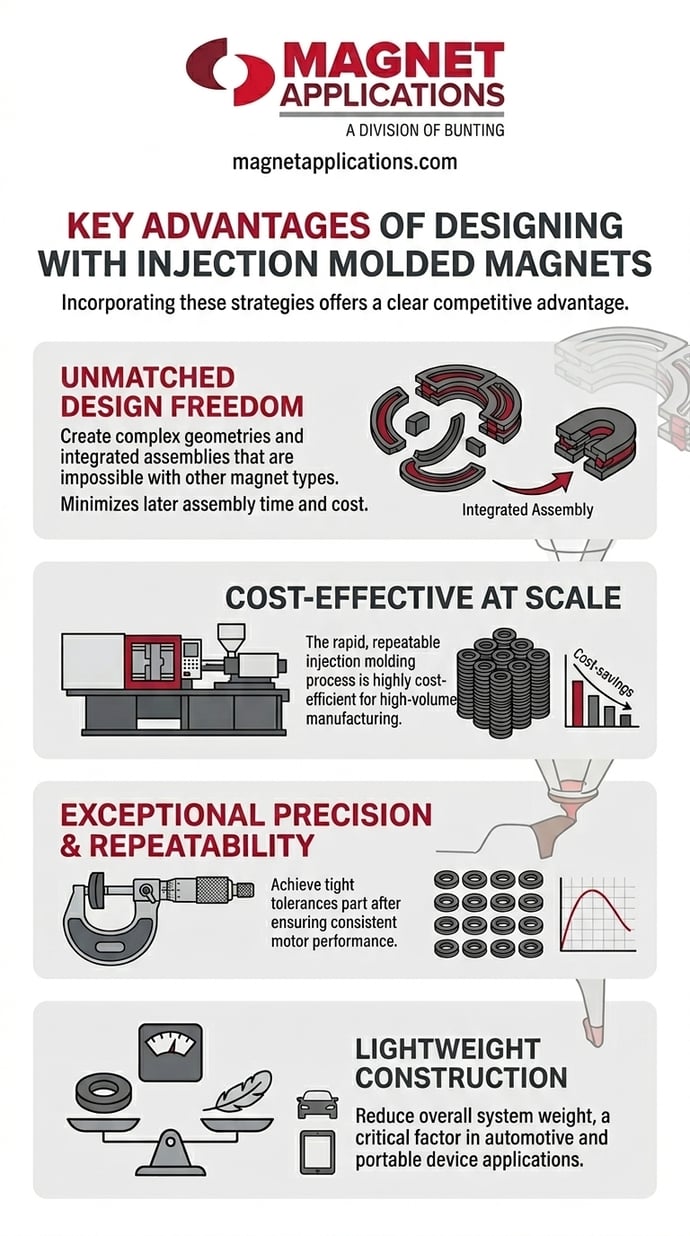
Incorporating these strategies with injection molded magnets offers a clear competitive advantage.
- Unmatched Design Freedom: Create complex geometries and integrated assemblies that are impossible with other magnet types. This type minimizes later assembly time and cost.
- Cost-Effective at Scale: The rapid, repeatable injection molding process is highly cost-efficient for high-volume manufacturing.
- Exceptional Precision & Repeatability: Achieve tight tolerances part after part, ensuring consistent motor performance.
- Lightweight Construction: Reduce overall system weight, a critical factor in automotive and portable device applications.
As you explore these innovative strategies, partnering with a supplier that offers comprehensive design and engineering support is crucial. For projects requiring a secure, domestic supply chain compliant with standards like RoHS, REACH, and DFARS, consider established U.S. manufacturers.
For more information on how injection molded magnets can be engineered for your specific motor design needs, please contact the experts at Magnet Applications, a Divison of Bunting, at https://www.magnetapplications.com/contact.
Frequently Asked Questions
How do injection molded magnets make electric motors smaller and lighter?
Injection molded magnets are a composite of magnetic powders and a lightweight polymer binder, which significantly reduces their density compared to traditional sintered magnets. The injection molding process also allows them to be formed into thin-walled, complex shapes that eliminate wasted space, enabling more compact and lightweight motor designs.
What is integrated component design in the context of injection molded magnets?
Integrated component design, also known as insert molding or overmolding, is a process where a structural part like a motor shaft or hub is placed directly into the mold. The magnetic material is then injected around it, creating a single, robust component. This simplifies assembly, reduces part counts, and improves precision by eliminating tolerance stacking.
How do injection molded magnets improve motor efficiency?
The design freedom of injection molding allows magnets to be created in custom shapes (curved, tapered, asymmetric) that optimize the magnetic flux path. This directs the magnetic field precisely where it's needed, minimizes air gaps between the rotor and stator, and reduces wasted energy, which significantly boosts motor torque and overall efficiency.
Can a single injection molded magnet have multiple magnetic poles?
Yes. A single, solid injection molded rotor can be magnetized with multiple north and south poles (e.g., 8, 12, or more) in a single step after molding. This technique is used to create complex magnetic fields that enable smoother motor operation and higher precision, which is difficult and costly to achieve with multiple, separate traditional magnets.