

To improve torque density using injection molded magnets, engineers should maximize the magnetic material loading within the polymer binder and leverage complex, net-shape geometries. This approach concentrates magnetic flux precisely where needed, optimizing the motor's power-to-volume ratio without requiring post-processing.
What You'll Learn
This article breaks down the key engineering strategies for enhancing motor torque density with injection molded magnets. You will learn:
- How to optimize the ratio of magnetic powder to polymer binder for higher flux density.
- The role that complex geometries and net-shape manufacturing play in focusing magnetic fields.
- Why multi-pole magnetization is a key advantage for improving torque and operational smoothness.
- The compounding benefits of lightweight design and component consolidation for overall system performance.
Understanding Torque Density and the Magnet's Role
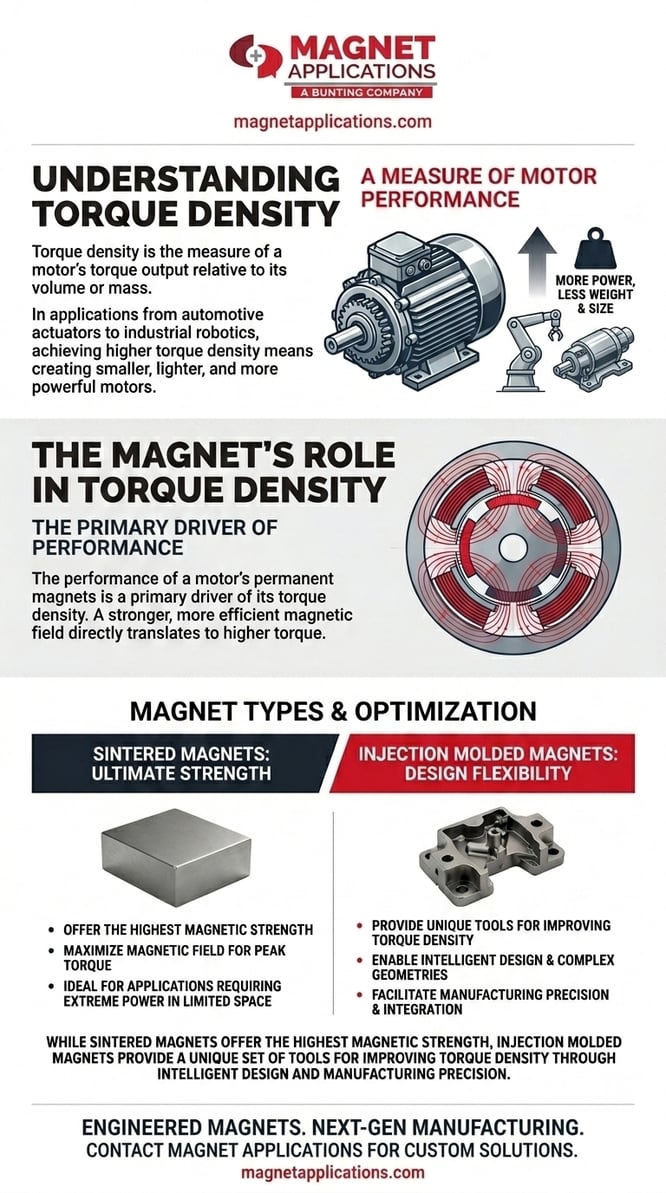
Torque density is the measure of a motor's torque output relative to its volume or mass. In applications from automotive actuators to industrial robotics, achieving higher torque density means creating smaller, lighter, and more powerful motors.
The performance of a motor's permanent magnets is a primary driver of its torque density. A stronger, more efficient magnetic field directly translates to higher torque. While sintered magnets offer the highest magnetic strength, Injection Molded Magnets provide a unique set of tools for improving torque density through intelligent design and manufacturing precision.
Key Strategies for Improving Torque Density with Injection Molded Magnets
Improving torque density with injection molded magnets is less about chasing maximum magnetic energy (like with sintered magnets) and more about strategic optimization.
Strategy 1: Maximize Magnetic Material Loading
The torque generated by a motor is directly related to its magnetic flux density. Injection molded magnets are composites, made by mixing magnetic powders—such as powerful Neodymium-Iron-Boron (NdFeB)—with a polymer binder like nylon.
The key is to work with a manufacturer to maximize the volume percentage of magnetic powder in the mix. A higher loading of NdFeB powder increases the magnet's overall energy product, resulting in a stronger magnetic field and, consequently, higher torque from the same size component.
Strategy 2: Leverage Complex Geometries and Net-Shape Manufacturing
This is the most significant advantage of injection molded magnets. Unlike traditional magnets which are limited to simple shapes, the injection molding process allows for the creation of highly intricate, net-shape parts in a single step.
Engineers can design magnets that fit perfectly within a motor rotor or stator assembly, minimizing air gaps and placing the magnetic material closer to the coils. This geometric precision allows the magnetic flux path to be tightly controlled and concentrated, directly boosting torque output without increasing the motor's size.
Strategy 3: Implement Advanced Multi-Pole Magnetization
The flexibility of the injection molding process makes it ideal for creating components with complex multi-pole magnetization patterns. A single injection molded rotor can contain numerous north and south poles arranged in a precise pattern (e.g., a Halbach array).
Increasing the pole count in a motor can lead to smoother operation and higher torque, especially at lower speeds. Injection Molded Magnets make achieving these sophisticated magnetization profiles both practical and cost-effective for high-volume production.
The Compounding Benefits of Injection Molded Magnets
The advantages of using injection molded magnets extend beyond direct torque improvements, contributing to better overall system performance.
- Lightweight Construction: The polymer binder makes these magnets significantly lighter than their sintered counterparts. A lighter rotor has lower inertia, allowing for faster acceleration and a more responsive system.
- Component Consolidation: An injection molded magnet can be molded directly onto a shaft or into another component. This reduces the total part count, simplifies assembly, and eliminates tolerance stacking issues, leading to a more robust and reliable motor.
- Cost-Efficiency at Scale: The process leverages rapid, repeatable production cycles. For the high volumes required in the automotive or consumer electronics industries, this makes Injection Molded Magnets a highly cost-effective solution for achieving optimized motor performance.
- Design and Supply Chain Security: Given the complexities of global supply chains, sourcing from a dependable domestic manufacturer is critical. U.S.-based suppliers can ensure compliance with standards like RoHS, REACH, and DFARS while providing integrated design and engineering support.
Conclusion: The Strategic Advantage of Precision
Ultimately, Injection Molded Magnets offer a powerful solution for improving torque density in modern motors, particularly in low-power rotational systems, sensors, generators, and actuators. They enable engineers to move beyond the constraints of raw magnetic strength and achieve superior performance through precision engineering, geometric optimization, and intelligent component integration. This unique combination of design freedom, manufacturing precision, and cost-effectiveness makes them an ideal choice for creating the next generation of efficient, compact motors.
Frequently Asked Questions
What is the primary advantage of using injection molded magnets for torque density?
The primary advantage is the ability to create complex, net-shape geometries. This allows engineers to design magnets that fit perfectly within a motor, minimizing air gaps and concentrating the magnetic flux path to directly boost torque without increasing the motor's size.
How does increasing magnetic material loading improve motor torque?
By maximizing the volume percentage of magnetic powder (like NdFeB) within the polymer binder, the magnet's overall energy product increases. This results in a stronger magnetic field, which directly translates to higher torque output from a component of the same size.
What is the benefit of multi-pole magnetization in injection molded magnets?
Multi-pole magnetization allows for creating numerous north and south poles in a precise pattern on a single component. This can lead to smoother motor operation and higher torque, especially at lower speeds, a design that is practical and cost-effective to achieve with injection molding.