
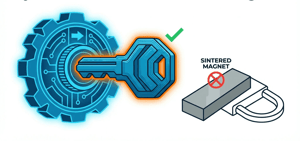
For precision sensors, injection molded magnets offer superior design flexibility, tighter dimensional tolerances, and greater cost-effectiveness at scale compared to traditional sintered magnets. Their ability to be molded into complex shapes makes them the ideal choice for modern, miniaturized sensor applications.
What You'll Learn
This article provides a direct comparison between injection molded and sintered magnets for engineers designing precision sensors. We will cover:
- The fundamental differences in manufacturing and material composition.
- A head-to-head analysis of key performance characteristics.
- Why Injection Molded Magnets are uniquely suited for advanced sensor design.
- Key factors to consider when choosing a magnet and a manufacturing partner.
Understanding the Core Technologies: A Quick Primer
Before comparing them, it’s essential to understand what makes these two types of magnets fundamentally different.
What Are Injection Molded Magnets?
Injection Molded Magnets are advanced composite materials. They are created by mixing magnetic powders—like Neodymium-Iron-Boron (NdFeB) or Ferrite—with a polymer binder, such as nylon or PPS. This mixture is then heated and injection molded, a process similar to manufacturing complex plastic parts. As these are Isotropic (meaning they have no preferred direction of magnetism) materials, they can later be magnetized into any shape or direction.
The result is a magnet that prioritizes intricate form and dimensional precision over raw magnetic strength. This process allows for the creation of complex, multi-pole magnets with tight tolerances that can be integrated directly with other components through over-molding or insert-molding. This minimizes later assembly time and cost.
What Are Sintered Magnets?
Sintered magnets are produced by pressing fine magnetic powders under extreme pressure and then heating them in a vacuum furnace (sintering) until the particles fuse together. This process creates a dense, solid magnet with very high magnetic strength.
However, sintered Neodymium (NdFeB) magnets are brittle, difficult to machine, and are generally limited to simple shapes like blocks, discs, and rings. They are also Anisotropic materials due to the process and must be magnetically aligned during pressing. They often require a protective coating to prevent corrosion and chipping.
Head-to-Head Comparison for Precision Sensors
When evaluating magnets for a sensor application, performance is measured by more than just magnetic field strength. Here’s how the two technologies stack up across the factors that matter most to engineers.
Design Flexibility & Complex Geometries
Winner: Injection Molded Magnets
Precision sensors, especially for automotive or medical applications, must fit into compact and often irregularly shaped assemblies.
- Injection Molded Magnets: Can be manufactured in virtually any shape imaginable. This allows engineers to design a magnet that fits the application perfectly, rather than designing the application around a standard magnet shape. They can also be over-molded onto shafts, gears, or other carriers, consolidating parts and simplifying assembly.
- Sintered Magnets: Are limited to simple geometries. Any complex features require expensive and difficult secondary grinding operations, which increases cost and the risk of micro-fractures.
Dimensional Tolerance & Precision
Winner: Injection Molded Magnets
Consistent and accurate sensor readings depend on the precise, repeatable placement of the magnetic poles.
- Injection Molded Magnets: The molding process is highly repeatable, yielding finished parts with extremely tight tolerances right out of the mold. This manufacturing consistency ensures uniform magnetic performance from one sensor to the next, reducing the need for individual calibration.
- Sintered Magnets: Tolerances are generally looser. Achieving high precision requires post-sintering machining, which adds cost and manufacturing time.
Magnetic Strength (BHmax)
Winner: Sintered Magnets
Sintered magnets contain a higher density of magnetic material, giving them a significantly stronger magnetic field (higher energy product) for their size.
- The Trade-Off: While sintered magnets are stronger, many sensor applications do not require the highest possible magnetic strength. Instead, they require a precisely shaped and located magnetic field. Injection Molded Magnets excel at providing this tailored field, which is often more critical for accuracy than raw power.
Manufacturing & Scalability
Winner: Injection Molded Magnets (for High Volume)
For medium to high-volume production runs common in consumer electronics, medical, and automotive industries, manufacturing efficiency is paramount.
- Injection Molded Magnets: The automated injection molding process allows for rapid cycle times and the production of millions of identical parts with minimal labor. This dramatically lowers the per-part cost at scale.
- Sintered Magnets: The multi-step process of pressing, sintering, machining, and coating is more labor-intensive and time-consuming, making it less cost-effective for very high volumes. Also there tends to be more wasted material in this process.
Durability & Environmental Resistance
Winner: Injection Molded Magnets
Sensors are often deployed in harsh environments with exposure to moisture, chemicals, and vibration.
- Injection Molded Magnets: The polymer binder encapsulates the magnetic particles, providing inherent resistance to corrosion and chipping. This plastic matrix also gives the magnet better mechanical strength and shock resistance compared to brittle sintered alternatives.
- Sintered Magnets: Are brittle and highly susceptible to corrosion, especially rare-earth variants like NdFeB. They almost always require a protective coating (like nickel or epoxy), which can be damaged and lead to premature failure.
Why Injection Molded Magnets Excel in Modern Sensor Design
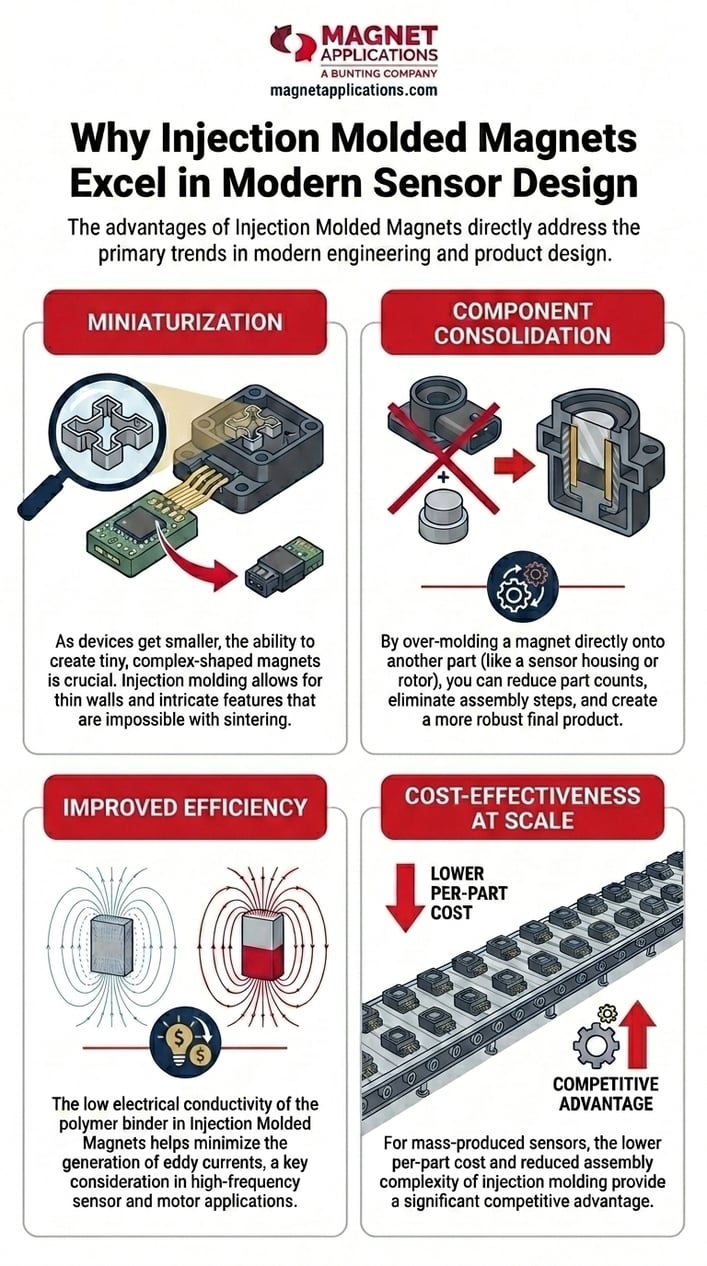
The advantages of Injection Molded Magnets directly address the primary trends in modern engineering and product design.
- Miniaturization: As devices get smaller, the ability to create tiny, complex-shaped magnets is crucial. Injection molding allows for thin walls and intricate features that are impossible with sintering.
- Component Consolidation: By over-molding a magnet directly onto another part (like a sensor housing or rotor), you can reduce part counts, eliminate assembly steps, and create a more robust final product.
- Improved Efficiency: The low electrical conductivity of the polymer binder in Injection Molded Magnets helps minimize the generation of eddy currents, a key consideration in high-frequency sensor and motor applications.
- Cost-Effectiveness at Scale: For mass-produced sensors, the lower per-part cost and reduced assembly complexity of injection molding provide a significant competitive advantage.
Choosing the Right Partner for Your Sensor Application
The full potential of this technology can only be realized with an experienced manufacturing partner. A turnkey provider like Magnet Applications offers comprehensive services that extend beyond simple production.
Their U.S.-based engineering teams can assist with material selection, magnetic field simulation, and designing complex shapes and over-molded components. With ISO 9001:2015 certified facilities and compliance with regulations like ITAR and DFARS, they provide the expertise and quality assurance needed for critical applications in the automotive, medical, and industrial sectors. By controlling the entire process from design to delivery, they ensure your Injection Molded Magnets meet the exact performance specifications your precision sensors demand.
Frequently Asked Questions
What is the primary difference between injection molded and sintered magnets?
Injection molded magnets are a composite material made by mixing magnetic powders with a polymer binder and molding them into a precise shape. Sintered magnets are created by compressing fine magnetic powders and heating them until the particles fuse together, resulting in a dense, solid magnet with high magnetic strength.
Which type of magnet is better for complex shapes and tight tolerances?
Injection molded magnets are far superior for complex shapes and tight tolerances. The molding process allows them to be manufactured in virtually any shape with high precision directly out of the mold, eliminating the need for costly secondary machining required for sintered magnets.
Are injection molded magnets stronger than sintered magnets?
No, sintered magnets have a significantly stronger magnetic field (higher BHmax) due to a higher density of magnetic material. However, many precision sensor applications prioritize a precisely shaped and located magnetic field over raw power, a key advantage of injection molded magnets.
Why are injection molded magnets often preferred for high-volume sensor manufacturing?
For high-volume production, injection molded magnets are more cost-effective due to automated, rapid cycle times that lower the per-part cost. They also offer greater durability, inherent corrosion resistance from the polymer binder, and the ability to consolidate parts through over-molding, which simplifies the overall assembly process.