
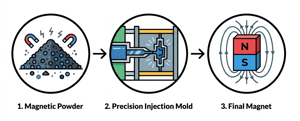
Injection molded magnets can be precisely engineered to meet specific magnetic field requirements for position sensors. This customization is achieved through a combination of material selection, complex mold shaping, and tailored post-production magnetization processes.
What You'll Learn
This article breaks down exactly how injection molded magnets are customized for high-precision applications like position sensors. Here’s a quick overview of what we’ll cover:
- The 3-Step Customization Process: How material composition, mold geometry, and magnetization work together to create a specific magnetic field.
- Why Shape Matters: How the unique ability to create complex shapes directly influences magnetic flux and sensor accuracy.
- Key Benefits for Sensor Design: Why injection molding offers superior repeatability, integration, and durability for sensor assemblies.
- The Importance of an Expert Partner: Why achieving optimal performance requires a provider with end-to-end engineering capabilities.
Why Position Sensors Demand Magnetic Precision
Modern position sensors—like those used in automotive steering systems, Medical applications, industrial robotics, and consumer electronics—rely on a predictable and stable magnetic field to function accurately. Any deviation in field strength or shape can lead to incorrect readings, performance issues, or outright failure.
This is why "off-the-shelf" magnets often fall short. Engineers require magnetic components that are not just magnetically strong enough to operate the sensor, but that project a precisely shaped and directed magnetic field. This is where the unique manufacturing process of Injection Molded Magnets provides a powerful solution.
Engineering the Perfect Magnetic Field: A 3-Step Process
Achieving a custom magnetic field isn't a single action but a multi-stage engineering process. Each step builds upon the last to deliver a component that meets the exact specifications of the sensor.
Step 1: Material Selection and Compounding
The foundation of any magnet's performance is its material composition. With injection molding, this is the first point of customization.
The process involves combining fine magnetic powders with a thermoplastic polymer binder, such as nylon or PPS. The specific magnetic output is controlled by:
- Magnetic Powder Type: Choosing between materials like Neodymium-Iron-Boron (NdFeB) for high strength or Ferrite for cost-effectiveness and corrosion resistance allows engineers to balance performance and budget.
- Fill Density: The ratio of magnetic powder to polymer binder is carefully adjusted. A higher concentration of magnetic powder results in a stronger magnetic field, while a lower concentration can be used for applications with less demanding requirements.
Step 2: Precision Shaping Through Injection Molding
This is where Injection Molded Magnets truly excel. Unlike sintered magnets, which are limited to simpler shapes, the injection molding process allows for the creation of intricate and complex geometries with extremely tight tolerances.
For a position sensor, the physical shape of the magnet directly dictates the shape of its magnetic field. By designing a custom mold, engineers can:
- Focus magnetic flux on a specific point.
- Create multi-pole configurations in a single, monolithic part.
- Design magnets that fit perfectly within compact or unconventionally shaped sensor housings.
- Incorporate features like holes, gears, or keyways directly into the magnet, simplifying the final assembly.
This ability to create an almost infinite variety of complex shapes makes it possible to design a magnetic field tailored to the sensor’s exact operational needs.
Step 3: Tailored Magnetization and Pole Configuration
After the part is molded, it is not yet magnetic or aligned in any direction of magnetic axis. The final and most critical step is magnetizing the component using a custom-designed fixture, which Magnet Applications can also supply, making it a one stop shop and guarantees that the specified magnetic characteristics are what is required for the application. This fixture exposes the part to a powerful magnetic field, aligning the magnetic particles within the polymer binder and creating the final poles.
This magnetization stage offers another layer of deep customization. By engineering the magnetizing fixture, it’s possible to define:
- The number of magnetic poles.
- The precise location of the North and South poles on the magnet's surface.
- The orientation of the magnetic field (e.g., axial, radial, or a complex multi-pole arrangement).
This final step "locks in" the desired magnetic field characteristics, ensuring the magnet will interact with the sensor element exactly as intended.
Key Benefits of Injection Molded Magnets in Sensors
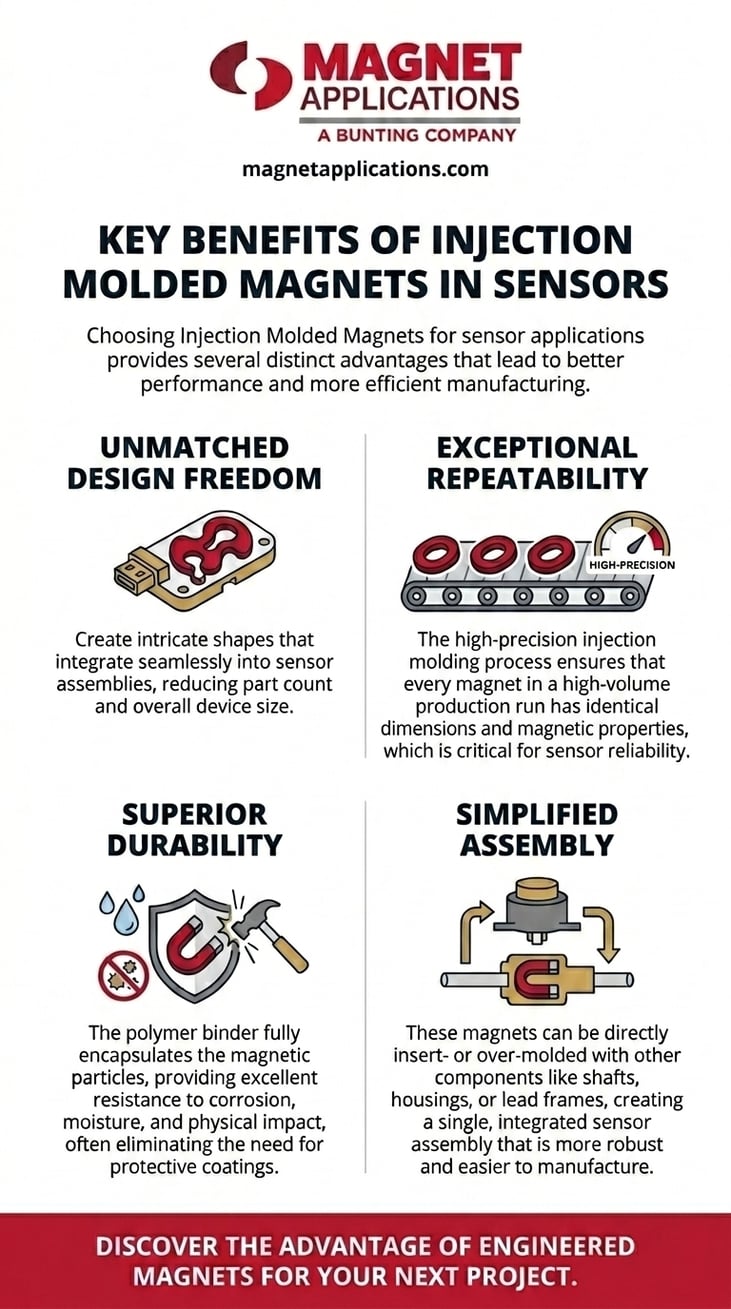
Choosing Injection Molded Magnets for sensor applications provides several distinct advantages that lead to better performance and more efficient manufacturing.
- Unmatched Design Freedom: Create intricate shapes that integrate seamlessly into sensor assemblies, reducing part count and overall device size.
- Exceptional Repeatability: The high-precision injection molding process ensures that every magnet in a high-volume production run has identical dimensions and magnetic properties, which is critical for sensor reliability.
- Superior Durability: The polymer binder fully encapsulates the magnetic particles, providing excellent resistance to corrosion, moisture, and physical impact, often eliminating the need for protective coatings.
- Simplified Assembly: These magnets can be directly insert- or over-molded with other components like shafts, housings, or lead frames, creating a single, integrated sensor assembly that is more robust and easier to manufacture.
Partnering with an Expert for Custom Sensor Magnets
Successfully developing a custom magnet for a sensitive application requires more than just a manufacturer—it requires a partner with deep expertise in magnetic materials, mold design, and magnetics engineering.
A full-service provider like Magnet Applications offers the turnkey services necessary to navigate this complex process. With U.S.-based engineering and ISO 9001:2015 certified production facilities, they manage the entire lifecycle from material selection and design to final magnetization and testing. This ensures that every component is optimized for its specific function within the sensor, delivering reliability and performance you can count on.
In conclusion, Injection Molded Magnets are not just customizable; they represent a highly engineered solution perfectly suited for the demands of modern position sensors. Their unique combination of material flexibility, shape complexity, and precise magnetization control allows engineers to move beyond standard components and design for optimal performance.
Frequently Asked Questions
How are injection-molded magnets customized for position sensors?
Customization is a three-step engineering process. First, the material is selected by compounding magnetic powders (like NdFeB or Ferrite) with a polymer binder to set the magnetic output. Second, injection molding creates intricate physical shapes that dictate the magnetic field's form. Finally, a tailored magnetization process uses a custom fixture to define the precise number, location, and orientation of the magnetic poles.
Why is the shape of an injection-molded magnet so important?
The physical shape of the magnet directly dictates the shape and direction of its magnetic field, which is critical for a position sensor's accuracy. The injection molding process allows for complex geometries that can focus magnetic flux, create multi-pole configurations, and incorporate features like holes or gears, simplifying assembly and enabling a perfect fit within compact sensor housings.
What are the key benefits of using injection-molded magnets in sensor design?
The main benefits include unmatched design freedom to create complex shapes, exceptional repeatability for reliability in high-volume production, and superior durability due to the polymer binder that resists corrosion and impact. They also simplify assembly, as they can be directly insert- or over-molded with other components to create a single, integrated part.