

Polymer binders are the critical-but-often-overlooked component that dictates the thermal, mechanical, and environmental performance of an injection molded magnet. Choosing the right binder is essential for ensuring the magnet’s durability, precision, and long-term reliability in its specific application.
What You'll Learn
This article breaks down the precise role of polymer binders in injection molded magnets. Here’s a quick overview of what we'll cover:
- The Core Function: What a polymer binder is and why it's essential.
- Performance Impact: How binders affect thermal stability, mechanical strength, and magnetic output.
- Common Binder Types: A look at standard and high-performance polymers like Nylon and PPS.
- Application-Specific Choices: How to match the right binder to the right job, from automotive sensors to micromotors.
What is a Polymer Binder in an Injection Molded Magnet?
Think of an injection molded magnet as a composite material. It consists of two primary ingredients: fine magnetic powders (like ferrite or neodymium-iron-boron) and a thermoplastic polymer binder.
The polymer binder acts as a matrix or "glue" that holds the magnetic particles together. During manufacturing, this mixture is heated until molten and then injected into a high-precision mold. The binder allows the material to flow and fill intricate cavities, which is how Injection Molded Magnets achieve their complex shapes and tight tolerances.
How Polymer Binders Directly Impact Magnet Performance
The type and percentage of the binder used have a direct and measurable effect on the final magnet's characteristics. Understanding these trade-offs is crucial for any design engineer.
Thermal Stability and Operating Temperature
A magnet's maximum operating temperature is often dictated by its binder. The polymer is typically the first component to degrade under heat, which can compromise the magnet's structural integrity.
- Nylon (PA6 or PA12): A common and cost-effective binder that provides good all-around performance. Injection Molded Magnets using a Nylon binder are suitable for applications with operating temperatures up to approximately 150°C (302°F).
- Polyphenylene Sulfide (PPS): A high-performance binder known for its superior thermal resistance and chemical stability. It allows magnets to function reliably in more demanding, high-heat environments, such as under the hood of a vehicle.
Mechanical Strength and Durability
The binder is solely responsible for the magnet's physical toughness. It provides resistance to shock, vibration, and chipping. A robust binder encases the magnetic particles, protecting them from environmental factors like moisture, which can cause corrosion in materials like neodymium. This makes Injection Molded Magnets highly durable and resistant to breakage compared to brittle sintered magnets.
Magnetic Strength (The Loading Factor Trade-off)
The polymer binder itself is not magnetic. This means every bit of volume it occupies is volume not occupied by magnetic material. This concept is known as the "magnetic loading factor."
- Higher Binder Content: Improves flow during molding, allowing for thinner walls and more complex geometries. It also increases mechanical strength. However, it lowers the overall magnetic strength (energy product).
- Lower Binder Content: Maximizes the magnetic loading, resulting in a stronger magnet. However, it can make the material more viscous and harder to mold into intricate shapes.
This trade-off is why Injection Molded Magnets offer lower magnetic strength than Compression Bonded or sintered magnets, but provide unparalleled shape flexibility and the ability to incorporate the magnetic material into the other parts, which is called over molding or insert molding.
Design Complexity and Precision
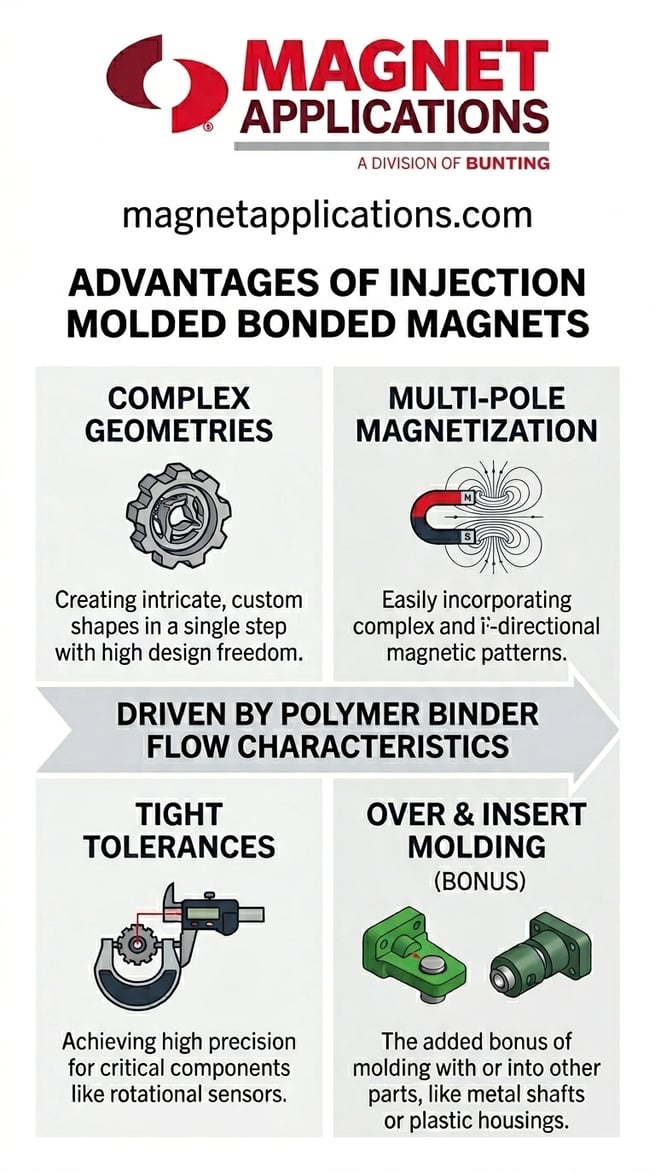
The flow characteristics of the polymer binder are what enable the key advantage of injection molding: design freedom. The process allows for:
- Complex Geometries: Creating intricate shapes in a single step.
- Multi-Pole Magnetization: Easily incorporating complex magnetic patterns.
- Tight Tolerances: Achieving high precision required for components like rotational sensors.
- And as an added bonus, the ability to be over or insert molded into other parts.
Matching the Binder to the Application
Choosing the right binder ensures the Injection Molded Magnet is optimized for its intended use case.
- Automotive Sensors: In rotational speed and position sensors, precision and thermal stability are key. A magnet with a PPS binder is ideal for under-hood applications, while a Nylon-based magnet works perfectly for in-cabin systems.
- Micromotors: For small motors that drive mirrors or automated vents, a balance of cost, mechanical strength, and precision is needed. A Nylon binder is often the perfect choice, providing the necessary durability and manufacturability.
- Actuators: These components require precise control and high resistance to environmental conditions. The protective qualities of the polymer binder make Injection Molded Magnets a reliable choice, preventing corrosion and ensuring long-term performance.
Conclusion: The Binder is Key to Performance
The polymer binder is far more than just a structural filler; it is a functional component that defines the performance profile of an injection molded magnet. By carefully selecting a binder, engineers can fine-tune a magnet’s properties to meet the exact thermal, mechanical, and magnetic requirements of an application. This level of customization is what makes Injection Molded Magnets an incredibly versatile and cost-effective solution for low-power rotational systems and complex sensor applications.
To ensure the security of your supply chain and compliance with standards like RoHS, REACH, and DFARS, consider sourcing U.S.-manufactured components. For more information on tailoring an injection molded magnet with the ideal polymer binder for your project, it is best to consult with an expert.
For design, engineering, and manufacturing support, please contact Bunting Magnetics at magnetapplications@buntingmagnetics.com.
Frequently Asked Questions
What is the role of a polymer binder in an injection molded magnet?
A polymer binder acts as a matrix or 'glue' that holds fine magnetic particles together. During manufacturing, it allows the molten mixture to flow and fill intricate cavities, which is essential for creating complex shapes and achieving tight tolerances in the final magnet.
How does the binder affect a magnet's operating temperature?
The binder choice directly dictates the magnet's maximum operating temperature, as the polymer is often the first component to degrade under heat. For instance, Nylon binders are suitable for temperatures up to 150°C (302°F), while a high-performance binder like Polyphenylene Sulfide (PPS) is used for more demanding, high-heat environments.
What is the trade-off between magnetic strength and binder content?
There is a direct trade-off known as the 'magnetic loading factor.' A higher percentage of binder improves mechanical strength and flow during molding for complex shapes, but it reduces the overall magnetic strength because the binder itself is not magnetic. Conversely, a lower binder content maximizes magnetic strength but makes the material more viscous and harder to mold.
Which polymer binder is best for high-heat automotive applications?
For high-heat automotive applications, especially under the hood, Polyphenylene Sulfide (PPS) is the ideal binder. It offers superior thermal resistance and chemical stability, allowing the magnet to function reliably in demanding environments where other binders like Nylon would fail.