

Temperature directly impacts bonded magnets in sensor applications by altering the polymer binder matrix. This can cause physical and magnetic instability, leading to dimensional shifts, signal drift, and measurement errors that compromise sensor accuracy and reliability.
What You'll Learn
- The Primary Weakness: Why the polymer binder, not the magnetic powder, is the component most vulnerable to temperature changes.
- Key Thermal Failure Modes: A breakdown of the three primary ways heat causes bonded magnets to fail, from dimensional shifts to material creep.
- Binder Performance Under Heat: A direct comparison of how common binders—Epoxy, Nylon, and PPS—behave at elevated temperatures.
- The "Failure Masquerade": How thermal degradation in a bonded magnet often appears as an electronic or calibration problem in a sensor system.
- Real-World Consequences: Specific examples of how these failures impact critical applications like downhole drilling and cryogenic systems.
The Core Issue: It's the Binder, Not Just the Magnet
When evaluating Bonded magnets for sensor applications, engineers often focus on the magnetic powder (like NdFeB or SmCo). However, the true limiting factor for thermal performance is the polymer binder—the epoxy, nylon, or PPS resin that holds the magnetic particles together.
This binder makes up a significant portion of the magnet's volume (from 15% to 40%). While it enables complex shapes and cost-effective production, it also introduces a "performance tax." The binder is more susceptible to thermal expansion, softening, and degradation than the metallic magnetic particles it encases. This vulnerability is the root cause of most temperature-related performance issues in sensors.
Key Thermal Failure Mechanisms in Bonded Magnets
Temperature doesn't just reduce a magnet's flux; in Bonded magnets, it attacks the structural integrity of the component, leading to failures that are often misdiagnosed. There are three primary thermal failure classes.
A1 - Ceiling Breach & Dimensional Shift
Every polymer binder has a glass transition temperature (Tg), the point at which it begins to soften. When a sensor's operating temperature exceeds the binder's Tg, the magnet's matrix softens and can change shape.
- How it Affects Sensors: This dimensional change can alter the critical air gap between the magnet and the sensing element. The sensor interprets this physical shift as a change in magnetic field strength, resulting in significant "sensor drift" that has no magnetic cause.
A2 - Differential Shrinkage & Residual Stress
During manufacturing, as the bonded magnet cools, the polymer binder shrinks significantly more than the stable magnetic powder particles. This creates residual stress at the interface between the binder and each particle.
- How it Affects Sensors: This built-in stress makes the magnet more vulnerable to thermal cycling. Over time, repeated heating and cooling can cause micro-cracks to form at the particle-binder interface, degrading the magnet's overall performance and leading to inconsistent sensor readings.
A3 - Creep Accumulation & Calibration Drift
Under sustained load and cyclic thermal loading, polymer binders can experience "creep"—a slow, permanent deformation. If the temperature cycles fall within the binder's viscoelastic relaxation spectrum, unrelaxed strain accumulates.
- How it Affects Sensors: The magnet physically moves or deforms over thousands of cycles. This is not a sudden failure but a gradual process that appears as slow, progressive calibration drift, often leading engineers to suspect the sensor electronics rather than the magnetic component.
How Binder Choice Dictates Thermal Performance
The choice of polymer binder is the single most important factor in determining a bonded magnet's suitability for a high-temperature sensor application.
- Epoxy-Bonded Magnets: These offer the highest magnetic performance due to a high fill fraction (up to 85% magnetic powder). However, they are brittle and generally limited to an operating ceiling of 80–120 °C. They are vulnerable to moisture and caustic chemicals, which can accelerate thermal degradation.
- Nylon-Bonded Magnets (PA12, PA6): Ideal for complex, injection-molded shapes, nylon binders also have a thermal ceiling around 80–120 °C. Their main weakness is high moisture absorption (hydrophilic), which causes swelling and can shift their thermal properties over long service lives.
- PPS-Bonded Magnets (Polyphenylene Sulfide): This is the superior choice for high-temperature applications. With a melting temperature around 280 °C, PPS-bonded magnets can operate reliably at temperatures up to approximately 175 °C. They also offer excellent mechanical strength and inherent corrosion resistance. Data shows a PPS-bonded magnet losing only 2.35% of its flux after 1000 hours at 175 °C.
The "Failure Masquerade": Why Thermal Issues Look Like Sensor Problems
A defining trait of Bonded magnets failures is that they rarely look like a magnet problem. This "Failure Masquerade Pattern" is a critical diagnostic principle for any engineer working with high-performance sensors.
| Actual Cause (Magnet Failure) | Apparent Symptom (System Error) |
|---|---|
| A1 thermal creep | Electronic calibration drift |
| B2 pressure differential | Sensor measurement error |
| B1 flex fatigue | Signal noise (in wearable sensors) |
The key takeaway is that when a sensor system exhibits unexplained drift, noise, or calibration anomalies, the bonded magnet's binder should be investigated as a potential root cause, especially if the device operates near its thermal limits.
Real-World Sensor Applications and Thermal Risks
Understanding the failure mechanism is crucial for designing reliable systems.
- Downhole Drilling Sensors: In this environment (150–200 °C and 20,000 psi), the hydrostatic pressure compresses the polymer binder more than the magnetic powder. This shifts the magnet's moment vector, corrupting directional sensor output. The problem presents as measurement drift and is often misdiagnosed as a calibration error.
- Cryogenic Liquid Hydrogen Valves: Here, the challenge is extreme cold (−253 °C) cycled with ambient temperatures. During cooldown, the polymer contracts far more than the magnetic powder, creating immense tensile stress. After 300-500 cycles, cracks can form and propagate, leading to sudden flux loss and potential valve failure.
The Engineering Takeaway: Qualifying Bonded Magnets for Temperature
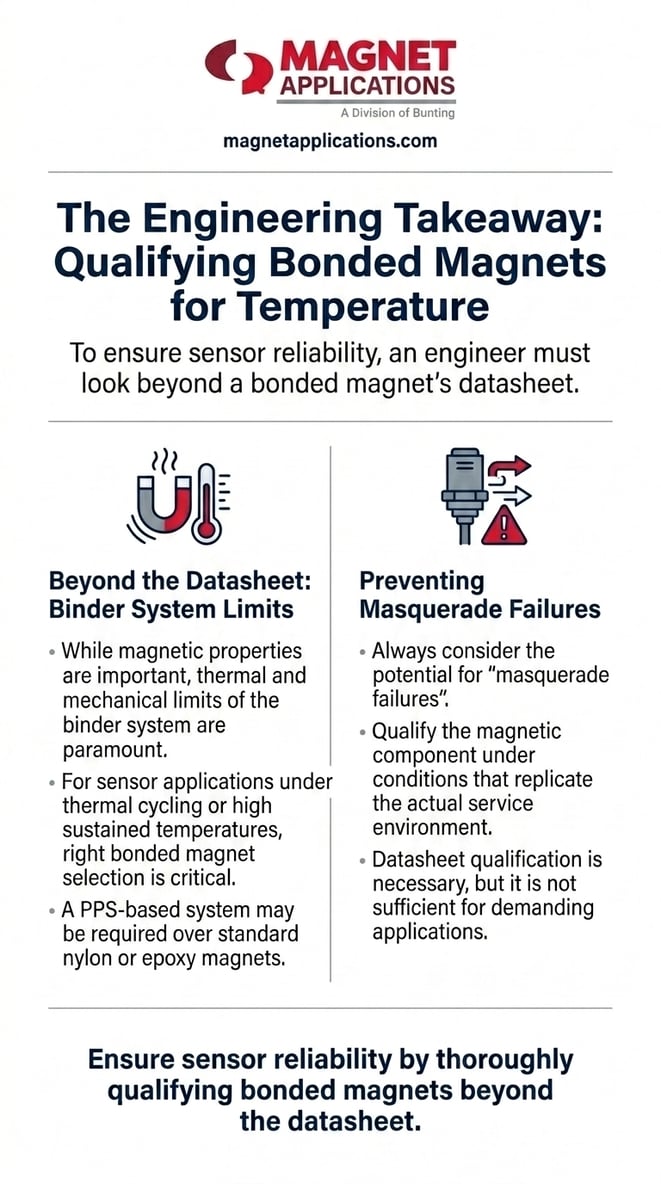
To ensure sensor reliability, an engineer must look beyond a bonded magnet's datasheet. While the magnetic properties are important, the thermal and mechanical limits of the binder system are paramount.
For any sensor application operating under thermal cycling, high sustained temperatures, or other combined stressors, the selection of the right Bonded magnets is critical. A PPS-based system may be required over a standard nylon or epoxy magnet. Always consider the potential for "masquerade failures" and qualify the magnetic component under conditions that replicate the actual service environment. Datasheet qualification is necessary, but it is not sufficient for demanding applications.
Frequently Asked Questions
What is the primary cause of temperature-related failure in bonded magnets?
The primary cause is the polymer binder (like epoxy, nylon, or PPS) that holds the magnetic particles together. The binder is more susceptible to thermal expansion, softening, and degradation than the magnetic powder itself, making it the true limiting factor for a bonded magnet's thermal performance in sensor applications.
Which polymer binder is best for high-temperature bonded magnet applications?
PPS (Polyphenylene Sulfide) is the superior choice for high-temperature applications. While Epoxy and Nylon binders are generally limited to 80–120 °C, PPS-bonded magnets can operate reliably at temperatures up to approximately 175 °C, offering excellent mechanical strength and corrosion resistance.
Why are failures in bonded magnets often misdiagnosed as electronic issues?
This occurs because thermal degradation causes physical changes in the magnet, such as dimensional shifts or gradual creep. A sensor interprets these physical changes as a variation in the magnetic field, resulting in symptoms like calibration drift or signal noise. These symptoms often lead engineers to incorrectly suspect the sensor's electronics rather than the magnetic component.