
Injection molded magnets can be precisely customized for specific motor designs by altering their physical shape, tailoring their magnetic material composition and density, and engineering complex multi-pole magnetic orientations directly into the part during manufacturing.
What You'll Learn
This article provides a comprehensive overview of how to leverage the unique properties of injection molded magnets for custom motor applications. You will learn about the three primary methods of customization:
- Shape and Geometry: How the injection molding process enables intricate designs that simplify assembly.
- Magnetic Properties: How to balance performance and cost by adjusting magnetic powders and binders.
- Magnetic Orientation: How multi-pole configurations can be engineered for optimal motor efficiency.
- Key Benefits: The performance, weight, and cost advantages of using a customized approach.
What Are Injection Molded Magnets?
Injection molded magnets are advanced composite materials made by mixing magnetic powders—such as powerful Neodymium-Iron-Boron (NdFeB) or cost-effective ferrite—with a polymer binder like nylon. This mixture is heated and injected into a precision mold, allowing it to cool and solidify into a durable, net-shape magnetic component.
This process combines the design freedom of plastic injection molding with the performance of magnetic materials, creating a solution perfectly suited for complex, low-power rotational systems.
The Two Pillars of Customization for Motor Design
True optimization in motor design comes from tailoring every component to the specific application. Injection molded magnets offer an unparalleled level of customization across these two key areas.
1. Customizing Shape and Complex Geometry
The primary advantage of injection molding is its ability to produce intricate shapes with extremely tight tolerances in a single step. This is impossible with traditional sintered magnets, which are brittle and require costly grinding for complex shapes.
- Integrated Components: You can design magnets that are molded directly over or into other components, such as shafts, bushings, or gears. This eliminates entire assembly steps, reduces potential points of failure, and lowers overall production costs.
- Intricate Features: Features like thin walls, precise cutouts, and complex curves can be incorporated directly into the magnet's design. This allows the magnet to fit perfectly within compact motor housings, maximizing space and efficiency.
- Net-Shape Manufacturing: The magnet emerges from the mold in its final form, requiring no secondary machining. This ensures exceptional part-to-part consistency, which is critical for high-volume automotive and sensor applications.
By leveraging injection molded magnets, engineers can move beyond simple block or ring shapes and design components that perform both a magnetic and a structural function.
2. Tailoring Magnetic Properties and Material Density
Not every motor needs the strongest possible magnet. Customization allows you to "dial in" the exact magnetic performance required, balancing strength, temperature resistance, and cost.
- Material Selection: The process starts with selecting the right magnetic powder. NdFeB offers the highest magnetic strength, while ferrite provides a highly cost-effective solution for less demanding applications.
- Binder-to-Powder Ratio: The ratio of magnetic powder to the polymer binder can be adjusted. A higher "loading" of magnetic powder increases the magnet's strength but may slightly reduce its mechanical durability. This allows for precise tuning of the magnet’s energy product (MGOe) to meet specific torque or sensing requirements.
- Lightweighting: The polymer binder makes injection molded magnets significantly lighter than their fully dense sintered counterparts. This is a critical advantage in applications where weight reduction is a priority, such as in electric vehicles (for range) and portable electronics.
Benefits of Customization with Injection Molded Magnets
Tailoring these magnets to your specific motor design delivers tangible engineering and business advantages.
- Enhanced Motor Performance: By optimizing the magnet's shape and magnetic field, you can achieve higher torque, better efficiency, and smoother motor operation.
- Miniaturization and Weight Reduction: Complex, integrated shapes and lower material density allow for smaller, lighter motor designs without sacrificing performance.
- Simplified Assembly and Reduced Costs: Molding magnets directly onto shafts or other components reduces part counts, eliminates adhesives, and shortens assembly time.
- High Durability and Resistance: The polymer binder provides excellent protection against chipping and cracking and offers inherent resistance to corrosion and common automotive fluids.
Choosing the Right Manufacturing Partner
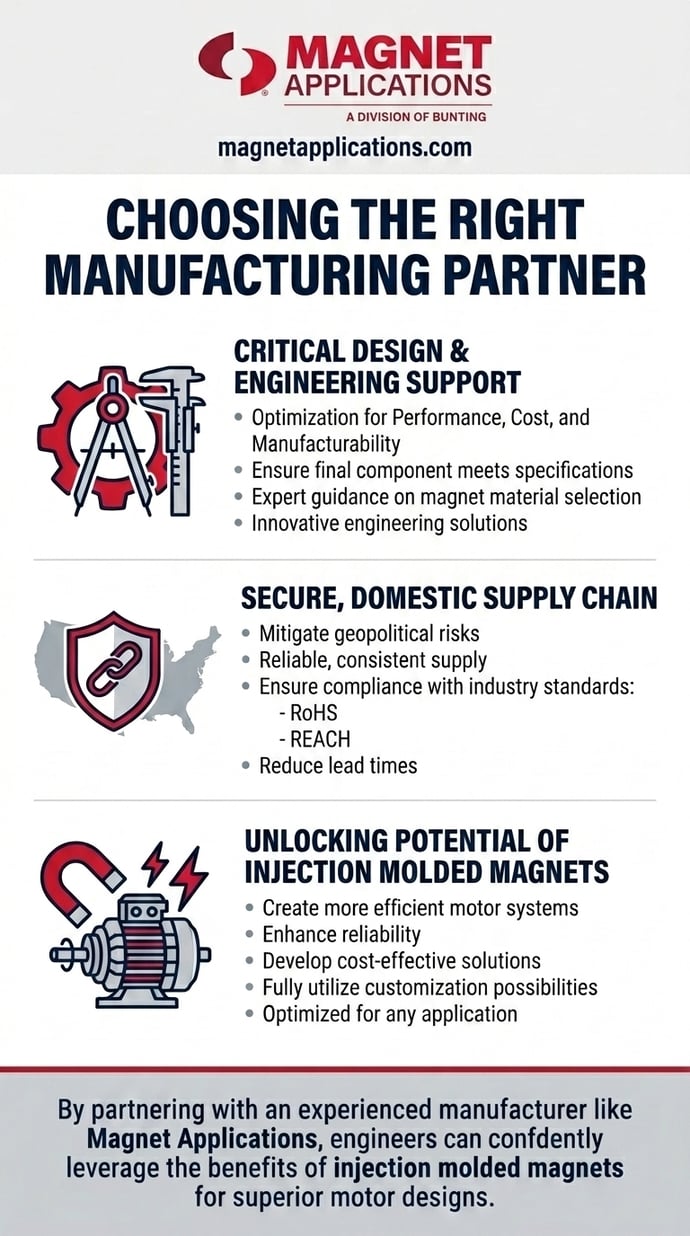
The success of a custom motor design depends heavily on the expertise of your magnet manufacturing partner. A capable partner provides more than just production; they offer critical design and engineering support to ensure the final component is optimized for performance, cost, and manufacturability. Look for a supplier with a secure, domestic supply chain to mitigate geopolitical risks and ensure compliance with industry standards like RoHS and REACH.
By understanding these customization possibilities, engineers can fully unlock the potential of injection molded magnets to create more efficient, reliable, and cost-effective motor systems for any application.
Frequently Asked Questions
What are the main ways to customize an injection molded magnet for a motor?
Injection molded magnets can be customized in three primary ways: by altering their physical shape and geometry to integrate with other parts, by tailoring their magnetic properties through material selection and density adjustments, and by engineering complex multi-pole magnetic orientations (like axial, radial, or Halbach arrays) directly into the component.
How do injection molded magnets help reduce assembly costs?
They reduce assembly costs by enabling net-shape manufacturing, where magnets can be molded directly over or into other components such as shafts, bushings, or gears. This integration eliminates entire assembly steps, reduces the total part count, and removes the need for adhesives.
Can the magnetic strength of an injection molded magnet be adjusted?
Yes, the magnetic strength can be precisely tuned. This is achieved by selecting the appropriate magnetic powder—such as high-strength Neodymium-Iron-Boron (NdFeB) or cost-effective ferrite—and by adjusting the ratio of magnetic powder to the polymer binder to meet specific performance requirements.
What kind of complex magnetic patterns can be created in an injection molded magnet?
Injection molded magnets can be manufactured with highly complex, multi-pole magnetization patterns. These include axial poles (on flat faces), radial poles (along the circumference), and advanced Halbach arrays, which concentrate the magnetic field on one side to significantly improve motor efficiency.