

Injection molded magnets offer superior design flexibility and are highly cost-effective for complex, high-volume production. Sintered magnets, by contrast, provide the highest magnetic strength and better temperature stability, making them ideal for high-performance, high-heat applications.
What You'll Learn
This article provides a direct comparison between injection molded and sintered Neodymium (NdFeB) magnets to help you make an informed decision. Here’s a quick overview of what we’ll cover:
- Core Differences: How the unique manufacturing process of each magnet type dictates its performance.
- Performance Metrics: A head-to-head analysis of magnetic strength, design complexity, durability, and cost.
- Ideal Applications: Clear use cases detailing when to choose an injection molded magnet over a sintered one, and vice versa.
- Quick-Reference Chart: A summary table for easy comparison.
Understanding the Core Differences: Process and Composition
The fundamental differences between injection molded and sintered magnets begin with how they are made. This manufacturing process directly impacts their final characteristics and suitability for various industrial applications.
How Injection Molded Magnets Are Made
Injection Molded Magnets are a type of bonded magnet. The process involves mixing fine magnetic powders—such as Neodymium-Iron-Boron (NdFeB) or Ferrite—with a polymer binder like nylon or polyphenylene sulfide (PPS). This composite material is then heated and injected under high pressure into a mold.
This single-step process allows for the creation of magnets with extremely complex and intricate shapes with high precision, directly out of the mold. It also allows for inserts like shafts or bushings to be molded directly into the magnetic component, streamlining assembly. As these are Isotropic (meaning they have no preferred direction of magnetism) materials, they can later be magnetized into any shape or direction.
How Sintered Magnets Are Made
Sintered magnets are created through powder metallurgy. A raw magnetic alloy is ground into a fine powder, pressed into a simple shape (like a block or disc) in the presence of a strong magnetic field, and then heated to a very high temperature in a vacuum furnace. This process, known as sintering, fuses the particles together, creating a dense, solid magnet with maximum magnetic strength. Sintered Neodymium (NdFeB) magnets are brittle, difficult to machine and are also Anisotropic materials due to the manufacturing process and must be magnetically aligned during pressing. They often require a protective coating to prevent corrosion and chipping.
Head-to-Head Comparison: Key Performance Metrics
Choosing the right magnet requires balancing multiple factors. Here’s how these two types stack up across the most critical metrics.
Magnetic Strength: The Powerhouse vs. The Precision Player
- Sintered Neodymium (NdFeB) Magnets: Offer the highest possible magnetic strength (BHmax) for their size. This makes them the undisputed choice for applications where raw power is the primary requirement, such as high-performance electric motors and heavy-duty generators.
- Injection Molded Magnets: Have a lower magnetic strength because the magnetic powder is mixed with a non-magnetic polymer binder. However, their strength is more than sufficient for countless low-power systems, especially where precision and complex magnetization patterns are more important than brute force.
Design Flexibility: Intricate Shapes vs. Simple Blocks
- Injection Molded Magnets: This is their defining advantage. The injection molding process allows for virtually unlimited shape complexity. You can create thin walls, varying cross-sections, and multi-pole magnetization patterns in a single piece. This process also allows for the creation of over-molding or insert-molding, thus minimizing future assembly time and cost. This design freedom is critical for components like sensors and micromotors in compact spaces.
- Sintered Magnets: Are limited to simple geometric shapes, such as blocks, rings and arc segments. Any complex features, holes, or steps must be added in costly and time-consuming secondary machining operations. This process is difficult because sintered materials are hard and brittle.
Durability & Environmental Resistance
- Injection Molded Magnets: The polymer binder encapsulates the magnetic particles, providing excellent protection against corrosion (rust) and preventing chipping or cracking. They are mechanically robust and can withstand shock and vibration well.
- Sintered Magnets: Are inherently brittle and easily chipped or cracked if mishandled. Sintered Neodymium magnets are also highly susceptible to corrosion and almost always require a protective coating (like nickel or zinc) to prevent degradation.
Temperature Stability
- Sintered Magnets: Generally have higher maximum operating temperatures. Specific grades of Sintered Neodymium, and especially Samarium Cobalt or Alnico, can operate in very high-heat environments.
- Injection Molded Magnets: The maximum operating temperature is limited by the polymer binder. They typically perform reliably up to about 150°C (302°F), which is suitable for a wide range of automotive and industrial applications but not for extreme-heat scenarios.
Cost & Production Efficiency
- Injection Molded Magnets: Are exceptionally cost-effective for high-volume manufacturing. The automated injection molding process is fast, repeatable, and produces net-shape parts that require no finishing. This dramatically reduces labor, time, and material waste, leading to a lower per-unit cost on large production runs.
- Sintered Magnets: The multi-step, energy-intensive process and the need for potential secondary machining make them more expensive, particularly for anything other than a standard shape.
Choosing the Right Magnet: Application Deep Dive
The best choice ultimately depends on your specific application needs.
When to Choose Injection Molded Magnets
Injection Molded Magnets are the ideal solution when design complexity, tight tolerances, and cost-efficiency at scale are the primary drivers.
- Complex Sensors: Used extensively in automotive and industrial rotational speed and position sensors. Their ability to be molded into precise, complex shapes with integrated multi-pole fields is essential for accurate sensing in compact assemblies.
- Micromotors and Actuators: Perfect for small motors that drive systems like automated vehicle vents, small pumps, or precision robotics. Their lightweight nature and design flexibility allow for optimized, efficient, and quiet motor designs.
- Integrated Assemblies: When a magnet needs to be molded over or around another component (overmolding), Injection Molded Magnets are the only practical choice. This consolidates parts, simplifies assembly, and improves the reliability of the final product.
- High-Volume Consumer Electronics: Where cost, repeatability, and intricate designs are critical for mass-market products.
When to Choose Sintered Neodymium (NdFeB) Magnets
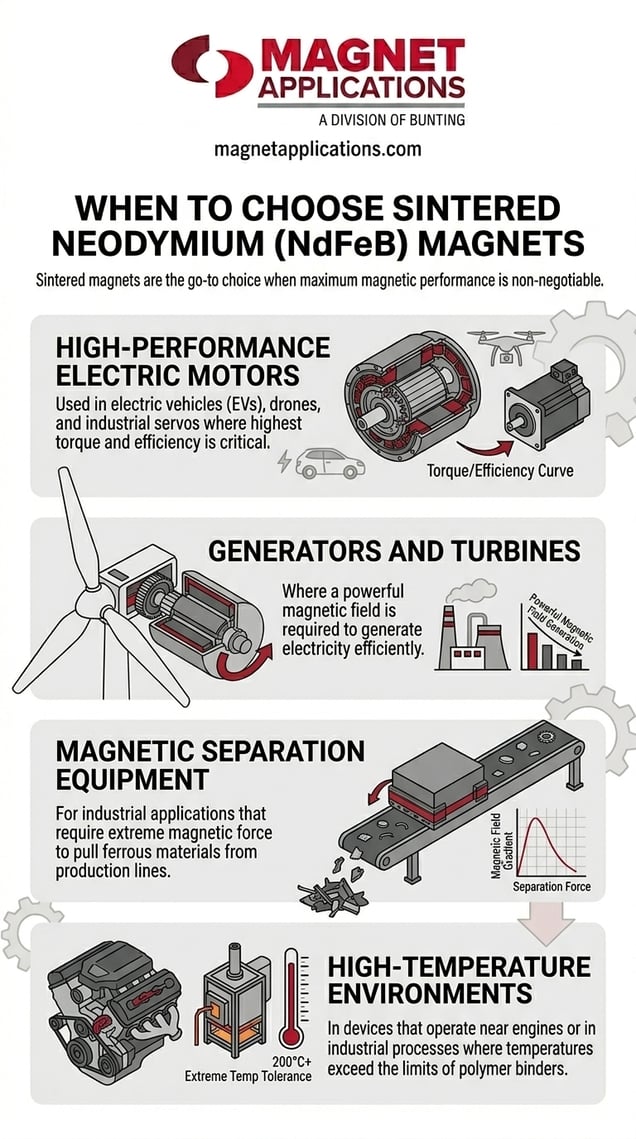
Sintered magnets are the go-to choice when maximum magnetic performance is non-negotiable.
- High-Performance Electric Motors: Used in electric vehicles (EVs), drones, and industrial servos where achieving the highest torque and efficiency is critical.
- Generators and Turbines: Where a powerful magnetic field is required to generate electricity efficiently.
- Magnetic Separation Equipment: For industrial applications that require extreme magnetic force to pull ferrous materials from production lines.
- High-Temperature Environments: In devices that operate near engines or in industrial processes where temperatures exceed the limits of polymer binders.
The Final Verdict: A Quick-Reference Comparison Table
| Feature | Injection Molded Magnets | Sintered Magnets |
|---|---|---|
| Magnetic Strength | Low to Medium | Very High |
| Shape Complexity | Very High (virtually unlimited) | Low (limited to simple shapes) |
| Dimensional Tolerance | Excellent (high precision from the mold) | Good (requires grinding for high precision) |
| Mechanical Strength | Good (robust, not brittle) | Poor (brittle, prone to chipping) |
| Corrosion Resistance | Excellent (binder protects particles) | Poor (requires protective coating) |
| Max Temperature | Medium (up to ~150°C) | High to Very High |
| Production Cost | Low for high volumes | High, especially for custom shapes |
| Best For | Complex sensors, micromotors, integrated assemblies, high volume. | High-power motors, generators, high-heat applications. |
Conclusion: Making the Strategic Choice for Your Project
The choice between injection molded and sintered magnets is a strategic one. It's a trade-off between the raw power of sintered magnets and the unparalleled design versatility and cost-efficiency of Injection Molded Magnets.
For engineers and designers developing next-generation products—especially in the automotive, consumer electronics, and medical device industries—the ability to create a precisely shaped, corrosion-resistant, and cost-effective magnetic component in a single step makes Injection Molded Magnets an enabling technology. While sintered magnets will always hold their place as the powerhouse option, the trend toward smarter, smaller, and more integrated designs overwhelmingly favors the flexibility of injection molding.
Frequently Asked Questions
What is the primary difference between injection molded and sintered magnets?
The primary difference lies in their manufacturing and composition. Injection molded magnets are a composite made by mixing magnetic powders with a polymer binder, allowing them to be formed into complex shapes. Sintered magnets are created by fusing pure magnetic powder under heat, resulting in a very dense, powerful magnet that is limited to simple geometric shapes.
Which type of magnet is stronger, injection molded or sintered?
Sintered magnets are significantly stronger. They offer the highest possible magnetic strength and are the premier choice for high-power applications like electric motors and generators. Injection molded magnets have lower magnetic strength because the magnetic particles are mixed with a non-magnetic polymer binder.
Why are injection molded magnets better for complex shapes and designs?
The injection molding process allows the magnetic composite to be injected into intricate molds, creating complex parts with high precision in a single step. Sintered magnets are hard and brittle, making them difficult and costly to machine into anything other than simple shapes.