
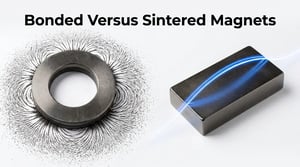
Selecting the right permanent magnet for an electric vehicle involves more than choosing the material with the highest magnetic strength. While sintered NdFeB magnets may be the preferred choice for many electric vehicle applications, bonded NdFeB magnets offer important advantages in applications where design flexibility, dimensional precision, multi-pole magnetization, and manufacturing efficiency are priorities.
Understanding the strengths and tradeoffs of each technology is essential for selecting the right solution. This article compares bonded and sintered NdFeB magnets, examining their magnetic performance, thermal capabilities, manufacturing processes, and ideal automotive applications, as well as the cost and supply chain consequences of each material.
The Structural Difference Between Bonded and Sintered NdFeB Magnets
The manufacturing process has a direct impact on the performance and application of an NdFeB magnet. While both bonded and sintered magnets use neodymium-iron-boron powder, the way that powder is processed results in significant differences in magnetic performance, mechanical properties, and design flexibility and cost.
Sintered NdFeB magnets are manufactured by compacting magnetic powder in a die under an applied magnetic field before sintering it at high temperature. This produces a fully dense, anisotropic magnet with excellent magnetic strength, making it well suited for applications where maximum energy product and size are the primary requirement. However, the material is also brittle and often requires secondary machining to achieve final dimensions.
Compression bonded NdFeB magnets combine the same magnetic powder with a resin binder before being compacted into a near-net-shape component. This creates an isotropic magnet capable of being magnetized in any direction and multi pole with equal energy product. Because part of the volume is occupied by the binder, bonded magnets have lower remanence (Br) and coercivity (Hc) than fully dense sintered magnets. However, they offer excellent dimensional consistency, greater design flexibility, and lower cost. As an example, Sintered NdFeB magnets are often produced as arc segments while bonded NdFeB magnets can be produced as rings and magnetized multi pole.
Evaluating Magnetic Performance and Multi-Pole Capabilities
When designing rotary encoders, Hall-effect sensors, and other precision sensing applications, the priority often shifts from maximum magnetic strength to precise, repeatable magnetic performance.
The Value of Isotropic Material in Sensor Applications
Because compression bonded magnets are isotropic, meaning they do not have a predetermined magnetic axis, they can be magnetized after manufacturing in a wide variety of patterns. This makes them particularly well suited for rotary encoders and other applications that require precise multi-pole magnetization to accurately detect speed and position.
By comparison, the anisotropic structure of sintered NdFeB magnets limits their ability to support complex multi-pole magnetization on a single, continuous component. Achieving similar magnetic patterns often requires multiple sintered segments or more complex assemblies. Compression bonded magnets can produce these patterns on a single part, simplifying assembly while improving consistency and repeatability.
In-House Magnetizing and Fixture Design
Producing a precision multi-pole magnet requires more than selecting the right material. It also requires specialized magnetizing equipment and fixtures designed specifically for the application.
Magnet Applications is the only manufacturer worldwide that designs and produces both magnets and magnetizers.
This unique capability allows us to optimize the magnet, fixture, and magnetization process together, helping ensure the finished magnet delivers the precise multi-pole pattern required for the application. It has the added benefit of the end customer only having one supplier for the finished magnet with guaranteed results.
With one billion bonded magnets produced in our state-of-the-art manufacturing facilities in DuBois, PA, our experience in custom magnetizing fixture design supports customers from material selection through final magnetization. This integrated approach helps simplify development and deliver consistent magnetic performance.
Operating Temperature and Environmental Durability
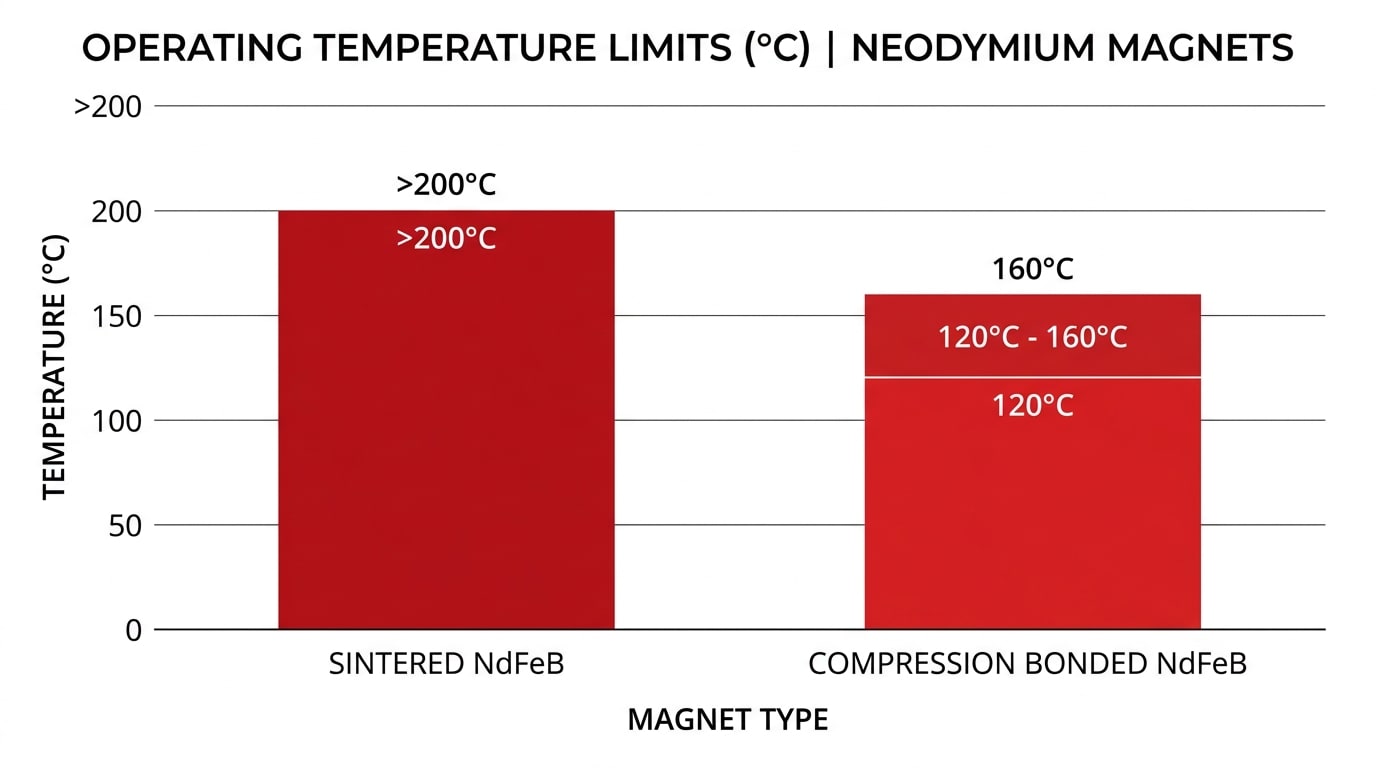
Selecting between bonded and sintered NdFeB magnets requires careful consideration of the application's operating temperature. While both materials offer excellent magnetic performance within their intended operating range, their thermal limits differ because of their manufacturing processes.
Sintered NdFeB magnets do not contain a polymer binder and can be formulated with heavy rare earth elements, such as dysprosium or terbium, to improve thermal stability for demanding, high-temperature applications. Depending on the grade, sintered magnets can operate well above 200°C.
Compression bonded NdFeB magnets use a resin binder that provides manufacturing and design advantages but also influences their maximum continuous operating temperature. Typical operating limits range from 120°C to 160°C, depending on the material grade and application. Engineers should also consider factors such as thermal exposure time, magnetic loading, and the operating environment when selecting a bonded magnet. Exceeding the recommended operating temperature can lead to degradation of the binder and irreversible loss of magnetic performance.
Coating Requirements for Automotive Environments
Unlike sintered NdFeB magnets, which typically require a protective plating to prevent corrosion, compression bonded NdFeB magnets benefit from the corrosion resistance provided by their resin binder. However, in automotive environments exposed to high humidity, road salt, or other corrosive conditions, additional surface protection may still be recommended to ensure long-term durability.
Epoxy and phenolic coatings are commonly used for bonded magnets in demanding environments. Because compression bonded magnets are manufactured as near-net-shape components with smooth, consistent surfaces, these coatings can be applied uniformly while maintaining tight dimensional tolerances.
Tooling Economics and Lead Times
For many prototype and early production programs, tooling costs and lead times play an important role in material selection. Custom sintered NdFeB magnets often require dedicated tooling followed by secondary machining to achieve final dimensions, increasing both lead times and non-recurring engineering (NRE) costs.
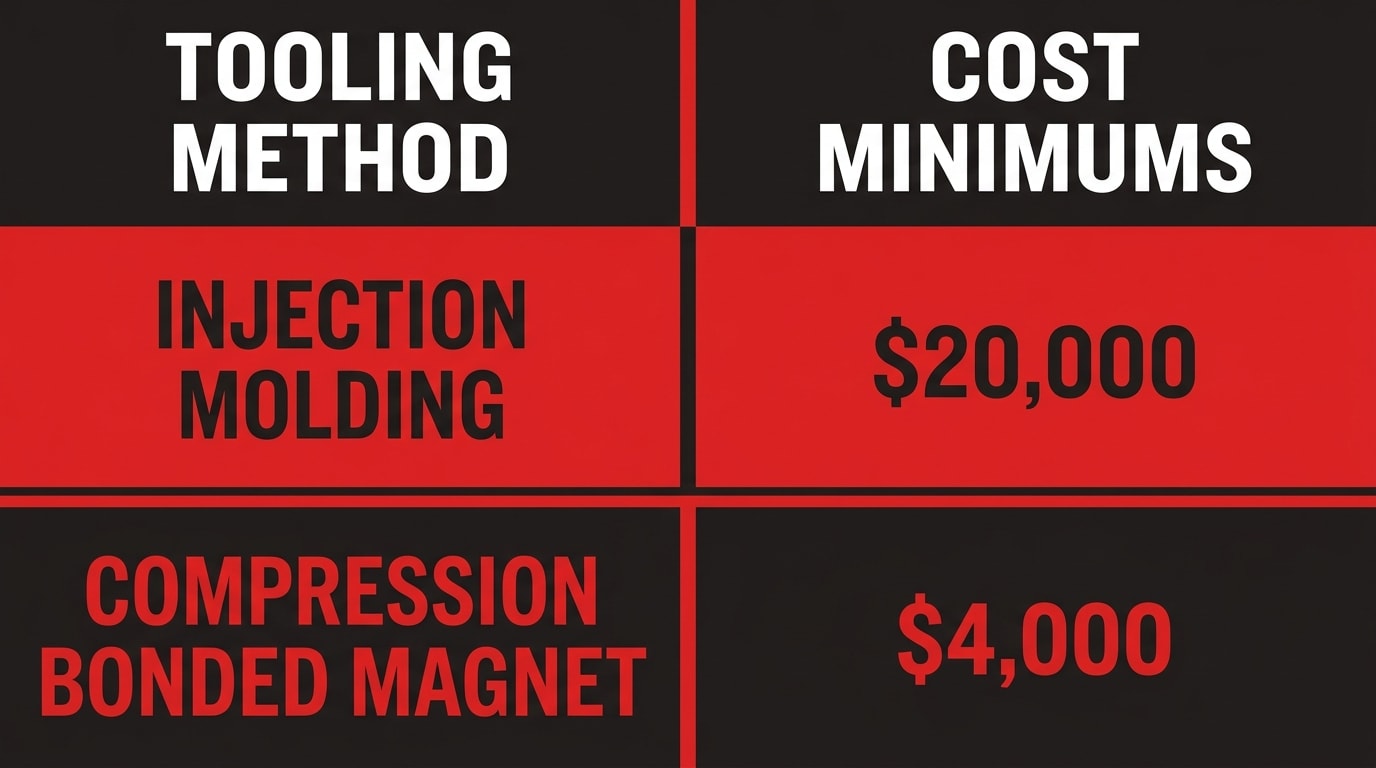
When evaluating alternatives, some design teams also consider injection molded magnets. While injection molding offers excellent design flexibility, the complexity of the tooling can result in significantly higher upfront costs, with tooling often starting around $20,000.
Compression bonded NdFeB magnets provide a cost-effective alternative for many applications. Typical tooling costs are closer to $4,000, and the vertical compaction process simplifies tool design while reducing development time. Because compression bonded magnets require less binder than injection molded magnets, they also achieve a higher magnetic energy product, making them an attractive option for applications that require a balance of performance, manufacturability, and cost. Injection molded magnets, meanwhile, are often better suited for high-volume applications requiring smaller, more complex geometries or integration with other components.
Utilizing Existing Sensor Geometry Inventories
For automotive R&D teams working under aggressive development schedules, reducing or eliminating new tooling can significantly shorten prototype lead times. Magnet Applications maintains an inventory of standard compression bonded tooling for common rotary encoder and Hall-effect sensor geometries, enabling many prototype programs to move forward without the cost and delay of custom tooling, as well as expensive magnetizing equipment.
With bonded magnet manufacturing capabilities in both the UK and the United States, we can support prototype and production programs closer to our customers in the Americas and Europe, while reducing lead times and supply chain complexity.
Domestic Production for North American OEMs
While many bonded magnets, especially for automotive applications, are manufactured overseas, Magnet Applications produces compression bonded NdFeB magnets at our DuBois facility. As the only domestic manufacturer of both compression bonded magnets and magnetizing equipment, we can support high-volume OEM programs from magnet production through final magnetization.
Domestic manufacturing helps reduce shipping lead times, simplifies communication, and gives engineering and quality teams the opportunity to conduct on-site audits and collaborate more closely throughout the product development process.
Dimensional Control and Automated Assembly
Dimensional consistency is critical for high-volume automotive production, where even small variations can affect assembly efficiency and product quality.
Sintered NdFeB magnets shrink during the sintering process and most times require secondary grinding or machining to achieve final dimensions. While these processes produce highly accurate parts, they can increase manufacturing time and cost.
Compression bonded NdFeB magnets are manufactured as near-net-shape components, allowing them to achieve tight dimensional tolerances directly from the tooling. Because little or no secondary machining is required, bonded magnets offer excellent part-to-part consistency and can simplify automated assembly.
For automated manufacturing processes, this dimensional consistency improves positioning accuracy and supports efficient, repeatable assembly.
Where Each Material Fits in EV Applications
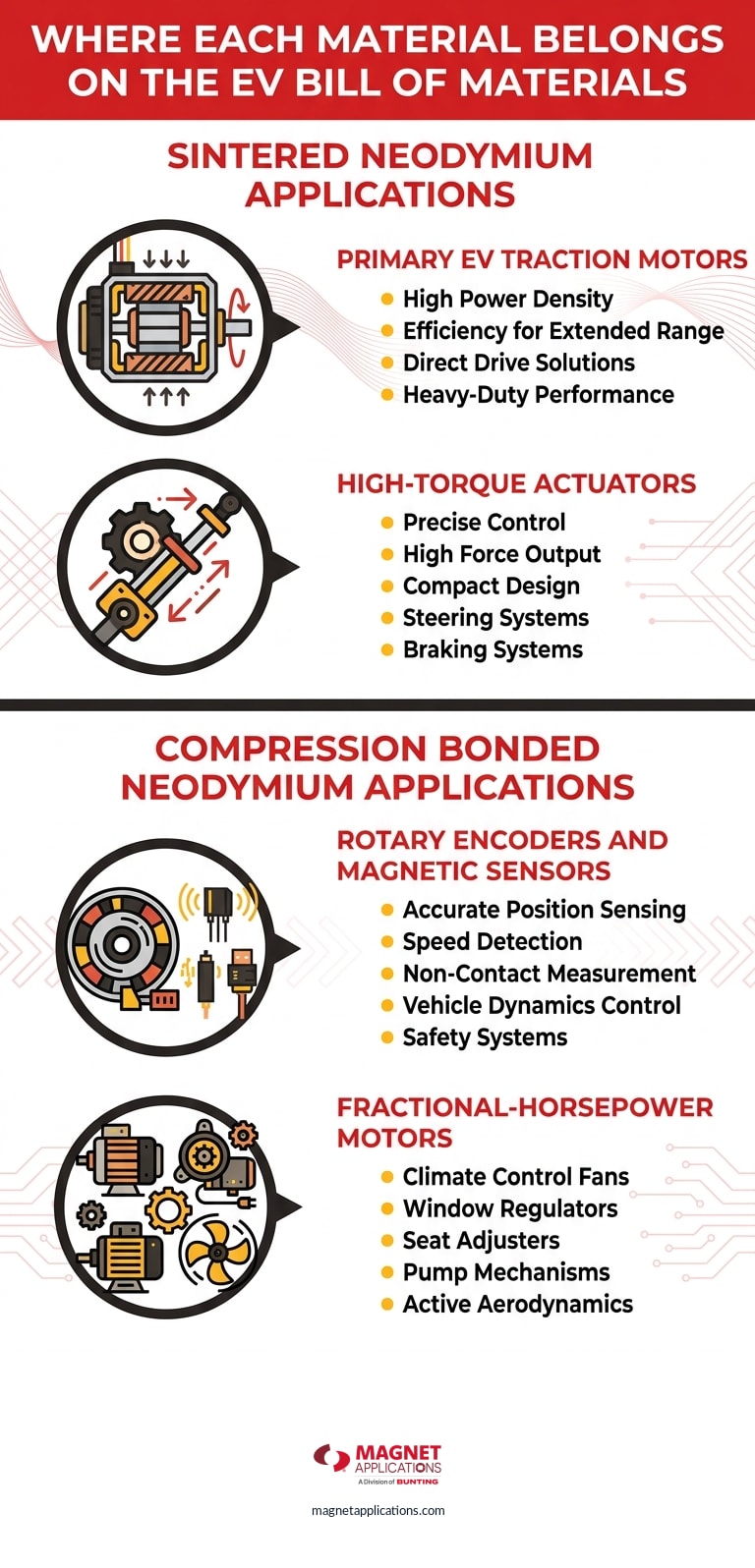
Choosing between compression bonded and sintered NdFeB magnets depends on the application's magnetic performance, operating environment, and manufacturing requirements. Each material offers distinct advantages depending on the design priorities.
Sintered NdFeB Applications
- Primary EV Traction Motors – Ideal where maximum energy density and high operating temperatures are the primary design requirements.
- High-Torque Actuators – Well suited for applications that require maximum magnetic strength within a limited installation space.
- High-Temperature Environments – Recommended for applications that consistently operate above 160°C, where higher thermal stability is required.
Compression Bonded NdFeB Applications
- Rotary Encoders and Magnetic Sensors – The isotropic structure supports precise multi-pole magnetization for accurate speed and position sensing.
- Auxiliary Motors – Applications such as coolant pumps, HVAC blowers, and seat motors benefit from near-net-shape manufacturing, dimensional consistency, and lower tooling costs.
- Thin-Walled Ring Geometries – Compression bonding can produce thin-walled rings and other complex geometries that would be difficult or costly to manufacture from sintered material. They can also be magnetized with multi-pole or skewed patterns.
Final Considerations
Selecting between bonded and sintered NdFeB magnets requires balancing magnetic performance, operating temperature, manufacturability, cost, and long-term production requirements. Sintered NdFeB remains the preferred choice where maximum magnetic strength and high-temperature performance are critical, while compression bonded NdFeB offers distinct advantages for applications that prioritize design flexibility, dimensional precision, multi-pole magnetization, and manufacturing efficiency.
Frequently Asked Questions