
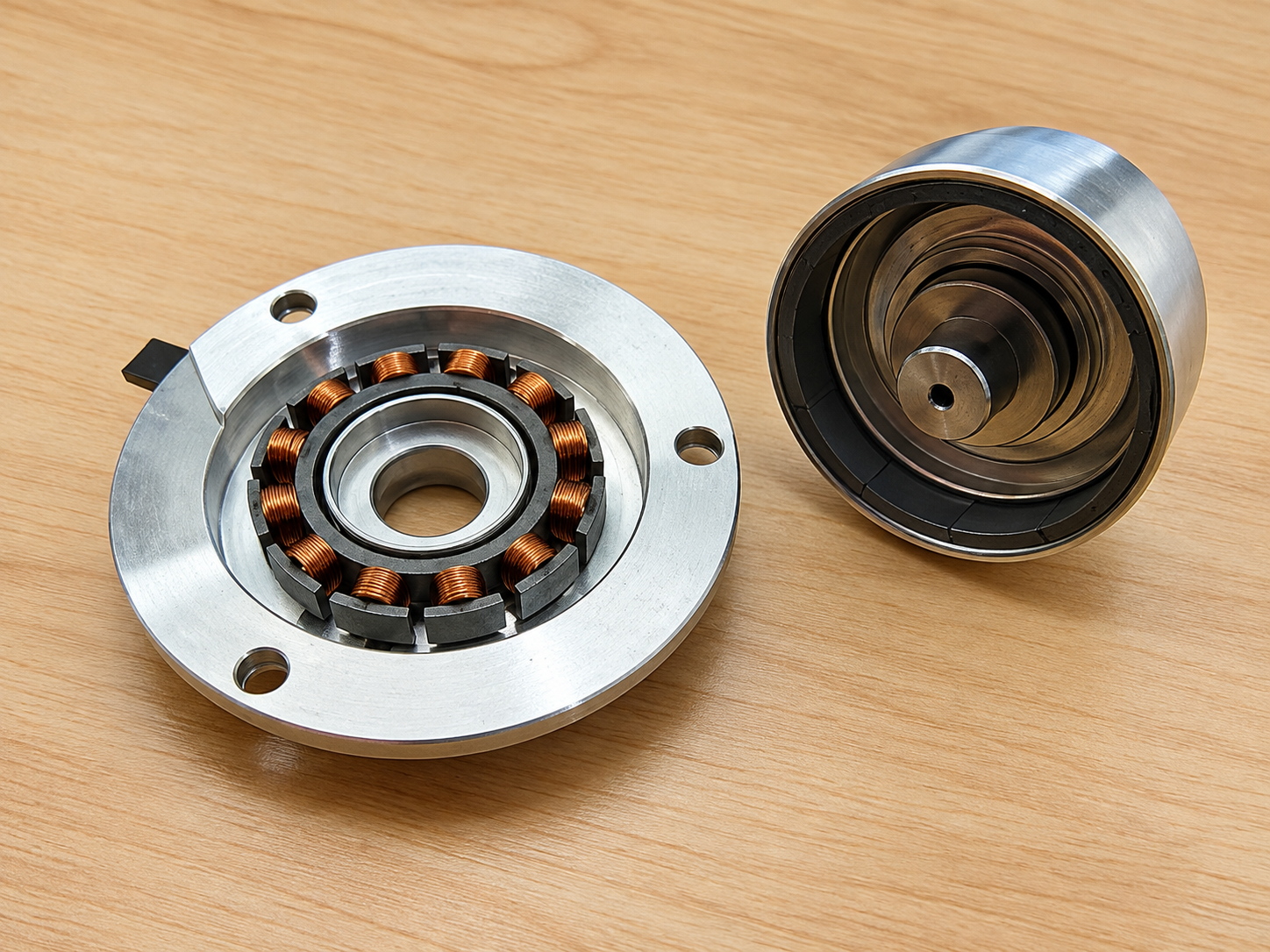
Traction motor prototypes often meet their torque density targets in simulation but fall short during testing when elevated temperatures begin to weaken magnetic performance. Selecting the right magnet also requires considering the overall performance goals of the motor. A higher-energy magnet such as sintered NdFeB can support greater power density, speed, and acceleration, while a lower-energy material such as bonded NdFeB may be better suited to designs that prioritize efficiency and driving range over maximum motor output.
Sintered neodymium magnets have long been the preferred choice for high-performance electric vehicle motors. As manufacturers look to improve supply chain resilience and reduce dependence on critical rare earth elements, interest in alternative magnet materials continues to grow.
In this blog, we'll examine the strengths and tradeoffs of the leading rare earth magnet technologies used in electric vehicle motors, including sintered NdFeB, heavy-rare-earth-free grades, bonded NdFeB, and samarium cobalt.
Rising Material Costs Are Driving Design Decisions
Rare earth magnet pricing has fluctuated significantly in recent years. Based on our experience with production programs, we've seen some NdFeB material costs increase by approximately 40 percent. As a result, many manufacturers are evaluating alternative materials and magnet grades to improve long-term cost stability and supply chain resilience.
For electric vehicle traction motors, however, replacing NdFeB entirely is rarely a practical solution. Materials such as ferrite or Alnico provide significantly lower magnetic energy, requiring larger magnets and, in many cases, a larger motor to achieve comparable performance. In applications where packaging space and torque density are critical, increasing motor size is often not an option.
Because of this, many engineering teams continue to specify sintered NdFeB while evaluating different grades to balance magnetic performance, thermal stability, cost, and rare earth content.
Material selection also has a direct impact on both vehicle cost and long-term supply chain planning. Many high-temperature NdFeB grades rely on heavy rare earth elements such as dysprosium and terbium to improve resistance to demagnetization at elevated operating temperatures. Because these elements have experienced price volatility and supply constraints, manufacturers are increasingly evaluating magnet grades that reduce or eliminate their use while still meeting performance requirements. The challenge is finding the right balance between thermal stability, magnetic performance, cost, and long-term availability.
Heavy-Rare-Earth-Free NdFeB Grades
Heavy-rare-earth-free (HREE-free) NdFeB grades are becoming an attractive option for manufacturers looking to reduce dependence on dysprosium and terbium. Advances in magnet manufacturing have made it possible for some HREE-free grades to deliver the required magnetic performance for many applications while reducing exposure to supply chain volatility.
Achieving this performance depends on carefully controlling the magnet's microstructure during manufacturing. Rather than relying on higher concentrations of heavy rare earth elements, manufacturers can use advanced processing techniques such as grain boundary diffusion (GBD) to improve coercivity and thermal stability while reducing the overall amount of heavy rare earth material required. However, the suitability of an HREE-free grade depends on the application's operating conditions, particularly maximum operating temperature and demagnetization requirements.
Before replacing a conventional NdFeB grade, engineers should validate that the alternative material meets the motor's thermal and magnetic performance requirements. When properly specified, HREE-free grades can provide a practical balance between performance, cost, and long-term material availability.
Is Samarium Cobalt the Right Alternative?
Samarium cobalt (SmCo) is sometimes considered as an alternative to NdFeB because of its excellent temperature stability and corrosion resistance. While it offers advantages in certain applications, it is not necessarily the best solution for every electric vehicle traction motor.
Compared with NdFeB, SmCo is generally more brittle, making it more susceptible to chipping or cracking during manufacturing and assembly. This can require additional handling precautions, particularly in high-volume production environments where magnets are press-fit, bonded, or retained within the rotor assembly.
SmCo also carries its own material availability and cost considerations. It typically comes at a higher price point than NdFeB, which can make it cost prohibitive for many applications unless operating-temperature requirements make SmCo the more suitable alternative. For many automotive applications, engineers instead evaluate HREE-free NdFeB grades that can meet the required performance while maintaining manufacturing processes similar to conventional NdFeB magnets. The right material ultimately depends on the application's operating temperature, performance requirements, production volume, and long-term supply strategy.
Operating Temperature and Demagnetization
NdFeB magnets are available in grades with maximum operating temperatures ranging from approximately 60°C to 230°C. However, these published values are only guidelines. The actual operating limit depends on the magnet's geometry, the magnetic circuit, and the application's operating conditions.
One of the key design considerations is the permeance coefficient, which influences a magnet's resistance to demagnetization. Magnets with lower permeance coefficients are generally more susceptible to irreversible magnetic losses at elevated temperatures than those with higher permeance coefficients.
The actual maximum temperature rating depends on the shape of the magnet and the design of the application. Exceeding the actual maximum temperature results in a permanent demagnetisation which is only recoverable by re-magnetisation. --Magnet Applications engineering team
If a magnet exceeds its allowable operating temperature within a given magnetic circuit, permanent demagnetization can occur. In many cases, re-magnetization may be possible, but in others the magnet may need to be replaced, depending on the application.
To reduce this risk, engineers should evaluate thermal loading early in the design process. Depending on the application, solutions may include:
- Improving the motor's cooling system.
- Optimizing magnet geometry to improve the permeance coefficient.
- Selecting an NdFeB grade with higher coercivity and thermal stability.
Corrosion Prevention with Ni-Cu-Ni Plating in Automotive Environments
Electric vehicle powertrains operate in environments where magnets may be exposed to moisture, condensation, road salt, and other contaminants throughout the life of the vehicle. Because sintered NdFeB magnets contain a high percentage of iron, they require a protective coating to resist corrosion and maintain long-term performance.
Ni-Cu-Ni (nickel-copper-nickel) plating is one of the most common coating systems for automotive applications, providing excellent corrosion resistance while maintaining tight dimensional tolerances. Other coatings, including epoxy and zinc, may also be suitable depending on the application's environmental conditions and assembly requirements.
For high-performance motor assemblies, coating thickness is an important design consideration. In applications with tight mechanical tolerances, engineers should account for the plating thickness when specifying magnet dimensions and include the coating requirements on production drawings to help ensure proper fit, reliable assembly, and consistent performance.
While protective coatings have proven effective for sintered NdFeB magnets, they also introduce an additional design consideration that engineers must account for when specifying the final assembly. This is one of several engineering tradeoffs to consider when evaluating permanent magnet technologies for automotive applications.
Certifications, Documentation, and Form Factor Flexibility
When sourcing magnets for automotive applications, procurement teams should verify that suppliers meet the required quality and environmental standards. Documentation supporting REACH and RoHS compliance, along with certified quality management systems such as ISO 9001, is often an important part of supplier qualification. Depending on the customer and application, additional certifications may also be required.
For automotive programs, suppliers should be prepared to provide documentation such as:
- Certificates of Conformity (CoC)
- Safety Data Sheets (SDS)
- Production Part Approval Process (PPAP) documentation, where required
These documents help verify that the supplied material meets the agreed magnetic, dimensional, and quality requirements while providing traceability throughout production.
Form Factor Flexibility
NdFeB magnets are available in a wide range of standard and custom geometries to suit different motor designs and applications. Common configurations include:
- Blocks and discs
- Rings
- Arcs
- Trapezoids
- Other custom geometries
The appropriate magnet geometry depends on the motor architecture, magnetic circuit, and manufacturing process. While sintered NdFeB is commonly used in many traction motor designs, applications requiring highly complex geometries, tighter dimensional control, or integrated features may benefit from alternative magnet technologies. Evaluating the magnetic, mechanical, and manufacturing requirements together helps ensure the selected magnet provides the best overall solution for the application.
When Bonded Magnets May Be the Better Choice
While sintered NdFeB remains the preferred choice for applications requiring maximum magnetic energy, it is not the ideal solution for every electric motor design. Bonded NdFeB magnets offer several advantages where design flexibility, manufacturability, and dimensional precision are equally important.
Because bonded magnets are molded rather than machined, they can be produced in complex geometries that may reduce secondary operations and simplify assembly. They also offer excellent dimensional consistency, support complex multi-pole magnetization patterns, and can be manufactured with integrated features that are difficult or impractical with sintered magnets.
For applications where ultimate magnetic strength is not the only design priority, bonded magnets can provide an effective balance of performance, manufacturing efficiency, and long-term reliability.
Final Engineering Considerations
Selecting the right magnet for an electric vehicle traction motor requires balancing magnetic performance, thermal stability, manufacturability, cost, and long-term material availability. While sintered NdFeB continues to play a major role in high-performance motor designs, advances in bonded magnets and heavy-rare-earth-free materials are giving engineers more options than ever before. Understanding the tradeoffs between these technologies is key to selecting the best solution for each application.
Magnet Applications manufactures compression bonded NdFeB magnets in DuBois, Pennsylvania, providing EV manufacturers with a domestic source for applications where bonded magnet technology is the right fit. Our engineering capabilities also extend to magnetizing equipment and fixtures, allowing the magnet and magnetization process to be considered together during development.
Before committing to production tooling, validate the selected magnet grade against the application's operating temperature, magnetic circuit, and performance requirements. Working with an experienced magnet manufacturer early in the design process can help ensure the chosen material, geometry, and coating are optimized for long-term reliability and manufacturability.
Frequently Asked Questions
► How do I prevent rare earth EV motor magnets from failing under peak thermal loads?
Preventing thermal demagnetization begins with understanding the motor's operating conditions. Engineers should evaluate expected temperatures, the magnetic circuit, and the permeance coefficient to ensure the selected magnet grade provides sufficient thermal margin. Depending on the application, improvements may include enhanced cooling, changes to magnet geometry, or selecting a higher-coercivity NdFeB grade.
► What documentation should I request from an EV magnet supplier?
Automotive suppliers should be able to provide documentation such as Certificates of Conformity (CoC), Safety Data Sheets (SDS), and PPAP documentation where required. These documents help verify material specifications, quality, traceability, and compliance with customer requirements.
► How do heavy-rare-earth-free NdFeB grades compare to Samarium Cobalt?
Heavy-rare-earth-free NdFeB grades can provide an effective alternative for many applications by reducing reliance on dysprosium and terbium while maintaining the performance required for the design. Samarium cobalt offers excellent high-temperature capability but is typically more brittle and may introduce different cost, manufacturing, and supply considerations. Material selection should always be based on the application's performance requirements.
► Why is Ni-Cu-Ni plating used on NdFeB magnets?
NdFeB magnets require protective coatings because of their susceptibility to corrosion. Ni-Cu-Ni plating is commonly used in automotive applications because it provides good corrosion resistance while maintaining tight dimensional tolerances. Engineers should also account for coating thickness when specifying final magnet dimensions.
► What happens if the permeance coefficient is too low?
A low permeance coefficient increases a magnet's susceptibility to irreversible demagnetization, particularly at elevated operating temperatures. Evaluating the magnetic circuit during the design phase helps engineers determine whether changes to magnet geometry or material selection are needed to achieve reliable long-term performance.