
Under high stress, bonded magnets in electric motors typically fail from four key mechanisms: thermal creep causing physical imbalance, hydrolysis in wet environments degrading the polymer binder, flex fatigue from vibration leading to micro-cracks, and demagnetization from high electrical currents during fault conditions.
What You'll Learn
This article provides a detailed engineering analysis of why bonded magnets fail in demanding motor applications. We will cover:
- The Four Primary Failure Modes: A breakdown of thermal creep, hydrolysis, flex fatigue, and electromagnetic demagnetization.
- Real-World Application Stressors: How environments in drones, e-bikes, and medical devices create unique challenges for magnet integrity.
- Binder-Specific Vulnerabilities: Why the choice of binder (e.g., Nylon, Epoxy, PPS) is critical for motor reliability.
- A Framework for Material Selection: Clear guidelines on when to choose bonded magnets over sintered alternatives to prevent premature failure.
The Four Primary Failure Modes of Bonded Magnets
While incredibly versatile, the performance of Electric Motors - Bonded Magnets is fundamentally tied to the integrity of their polymer binder system. High-stress environments attack this binder, leading to failures that are often misdiagnosed as other mechanical or electrical issues.
1. Thermal Creep: The Silent Imbalance
In motors that constantly cycle between low and high loads, such as in variable-speed pumps or HVAC blowers, the bonded magnet ring is subjected to continuous heat cycling. This thermal variation can cause the polymer binder to soften and deform over thousands of cycles, a phenomenon known as thermal creep.
This isn't a sudden failure. Instead, the magnet physically migrates on the rotor, leading to a progressive mechanical imbalance.
- Failure Signature: The motor becomes noisier over time, exhibiting increased vibration or "cogging." These symptoms are often mistaken for bearing wear or shaft runout, while the root cause in the magnet goes undetected.
- Key Stressor: Differential thermal expansion between the steel motor shaft and the polymer-bonded magnet ring creates persistent stress at the bond interface, accelerating creep.
2. Hydrolysis: When Moisture Becomes a Menace
For motors operating in continuously wet environments like washing machines, submersible pumps, or food processing equipment, hydrolysis presents a significant threat.
Moisture, especially when combined with detergents or caustic solutions, penetrates micro-cracks in the magnet's epoxy or nylon binder. This initiates a chemical breakdown of the polymer at the surface, exposing the raw NdFeB magnetic powder. The exposed iron content then oxidizes, contaminating the surrounding environment.
- Failure Signature: This failure is often invisible to standard magnetic tests. Internal flux density may remain high, but the magnet's surface integrity is compromised. The process typically takes 18-24 months of daily wet cycling to cause meaningful degradation.
- Key Stressor: The combination of moisture and chemical agents directly attacks the binder, making material selection crucial for any wet-environment Electric Motors - Bonded Magnets.
3. Flex Fatigue: Cracking Under Pressure
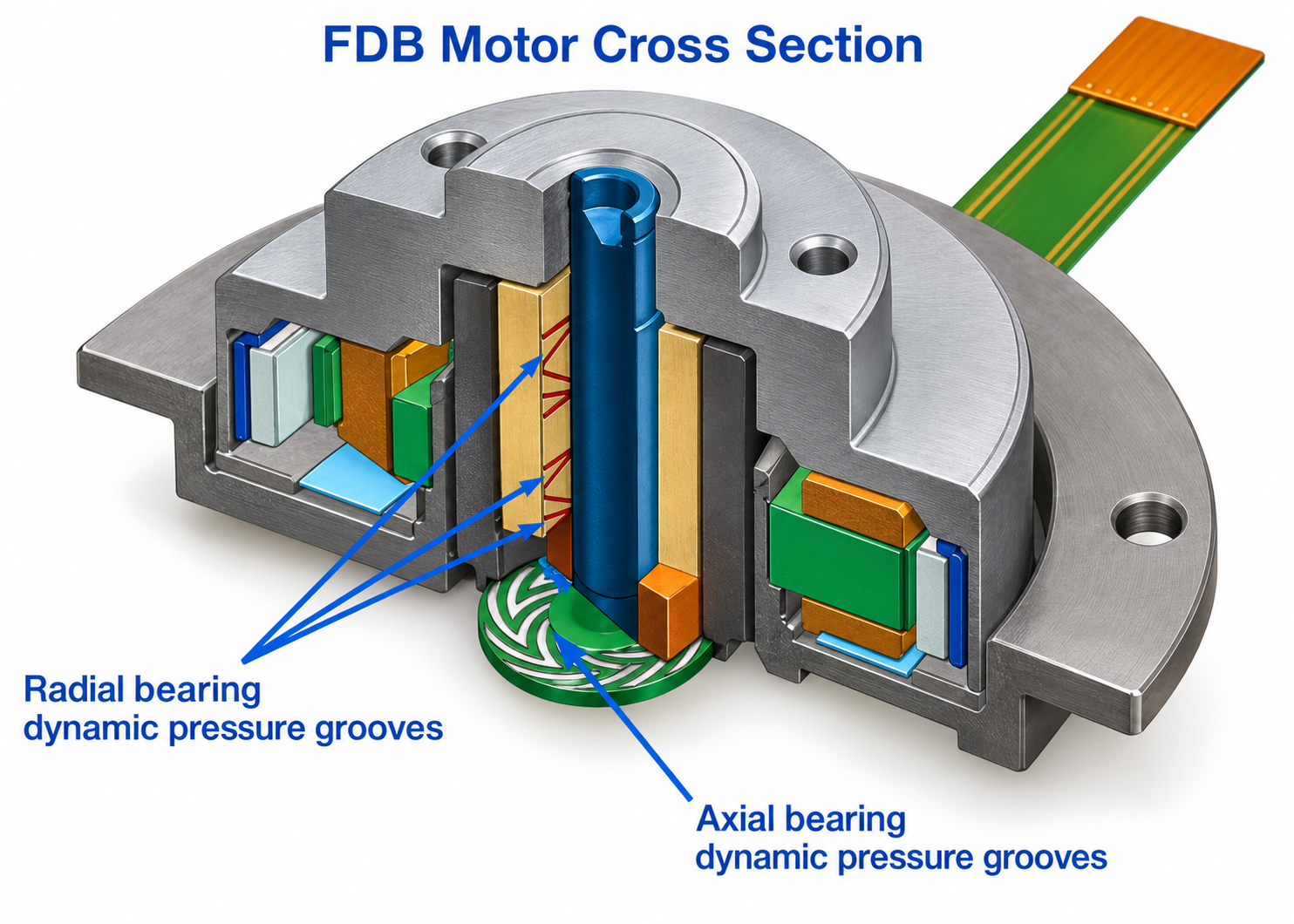
Cross-section of an FDB motor showing internal motor and bearing components
High-vibration applications, such as handheld power tools and drone propulsion motors, impose repeated mechanical shocks on the magnet. This leads to flex fatigue, where micro-cracks initiate at the interface between the magnetic particles and the binder matrix.
This damage begins on a microscopic level and requires no visible surface defect to start. Over time, these cracks propagate, degrading the magnet's overall structural and magnetic integrity.
- Failure Signature: A gradual decline in motor performance. Users may notice reduced no-load speed or a loss of torque under load. This is often misdiagnosed as brush wear or winding degradation.
- Key Stressor: Constant, high-frequency vibration is the primary driver. The lightweight nature of bonded magnets is an advantage in these applications, but it requires careful design to mitigate fatigue.
4. Electromagnetic Demagnetization: A Fault-Induced Failure
This failure mode is not caused by binder degradation but by an extreme electrical event. When a motor controller faults, it can dump a massive current into the windings. This creates a powerful magnetic field that can be strong enough to permanently weaken or demagnetize the bonded magnet.
Electric Motors - Bonded Magnets have inherently lower coercivity (resistance to demagnetization) than their sintered counterparts. This vulnerability is magnified at high temperatures, as the coercivity of NdFeB material drops significantly as it heats up.
- Failure Signature: A sudden and permanent loss of motor torque.
- Key Stressor: The combined effect of a high-current fault event occurring while the motor is at its peak operating temperature. This worst-case scenario is a critical consideration for engineers designing servo motors and other high-precision systems.
How Stressors Manifest in Specific Applications
Understanding the theoretical failure modes is one thing; seeing how they play out in the real world is another.
- Drone Propulsion Motors: These motors face a brutal combination of rapid thermal cycling (heating on ascent, cooling on descent) and constant vibration. This creates a combined stressor scenario where thermal creep and flex fatigue can accelerate failure.
- E-Bike Hub Motors: E-bikes expose motors to a gauntlet of environmental attacks. The combination of outdoor temperature swings, moisture, road salt, and continuous torque ripple creates a unique combined stressor profile that attacks the binder through both hydrolysis and thermal creep.
- Medical Device Motors: Motors in surgical tools must endure sterilization processes like steam autoclaving (high heat and moisture) or gamma irradiation. These processes can severely degrade the polymer binder in ways not covered by standard industrial datasheets, creating a critical qualification gap.
A Framework for Preventing Failure
Identifying failure modes is the first step. Preventing them requires a strategic approach to material selection. When designing with Electric Motors - Bonded Magnets, the choice of binder and magnet type is paramount.
When to Choose Bonded vs. Sintered Magnets
Choose Bonded Magnets when:
- Complex shapes or thin-walled designs are required (injection molded) up to 5MGOe.
Single-piece multi-pole rings are needed in one process step (compression bonded) up to 12 MGOe. - The application is high-volume and cost-sensitive.
- Thin walls and tight dimensional tolerances (±0.05mm) are needed without secondary grinding (injection molded).
- The motor's operating temperature will consistently remain below 175°C.
Choose Sintered Magnets when:
- Maximum possible torque density is the single most important factor.
- Operating temperatures will regularly exceed 175°C.
- The highest possible resistance to demagnetization from fault currents is required.
By understanding the distinct failure modes associated with the polymer binder system, engineers can better design and specify Electric Motors - Bonded Magnets for improved long-term reliability, even in the most demanding high-stress applications.
Frequently Asked Questions
How do bonded magnets improve electric motor efficiency?
Bonded magnets enhance motor efficiency by enabling complex geometries that optimize magnetic circuits, reducing electrical losses like eddy currents through their high resistivity, and improving thermal management via integrated designs like overmolding.
How do bonded magnets reduce electrical losses in motors?
The magnetic powder particles in bonded magnets are suspended in a polymer binder. This binder acts as an electrical insulator between particles, dramatically increasing the material's overall electrical resistivity. This high resistivity suppresses the formation of energy-wasting eddy currents, especially in high-frequency applications.
Why are bonded magnets better for complex motor designs?
Unlike brittle sintered magnets, injection molded bonded magnets can be molded into highly complex, net-shape components with very tight tolerances. This allows for the creation of single-piece multipole rings and precise air gap control, which reduces mechanical losses and improves magnetic coupling without costly machining or assembly of multiple segments.
In which applications are bonded magnets the most efficient choice?
Bonded magnets provide a superior efficiency solution for applications involving multipole geometries (more than 6 poles), high-volume production like automotive or appliance motors, complex integrated designs where the magnet is overmolded onto a shaft, and high-frequency operation.