

Injection molded magnets slash production costs for magnetic sensing systems by enabling complex, single-piece designs that reduce assembly steps. Their high-speed, low-waste manufacturing process is ideal for achieving consistent quality at scale, directly lowering the per-unit price.
What You'll Learn
This article breaks down the specific cost benefits of using injection molded magnets for high-volume manufacturing. You will learn how this technology directly impacts your bottom line by:
- Reducing Assembly Costs through part consolidation and over-molding.
- Minimizing Material Waste with precise, near-net-shape manufacturing.
- Achieving High-Volume Scalability with rapid, repeatable cycle times.
- Enhancing Durability and eliminating the need for costly secondary processes.
The Core Challenge: Cost vs. Precision in Magnetic Sensing Systems
In large-scale production, especially for industries like automotive and consumer electronics, manufacturers face a constant challenge: how to produce highly precise magnetic sensing systems without letting costs spiral out of control. Traditional methods often involve multi-part assemblies using sintered magnets, which require expensive machining, adhesives, and manual labor, driving up the cost per unit and introducing potential points of failure.
This is where a strategic shift in material selection becomes a powerful financial lever. Injection Molded Magnets offer a solution that fundamentally redesigns the manufacturing process for maximum cost-efficiency.
How Injection Molded Magnets Drive Down Costs
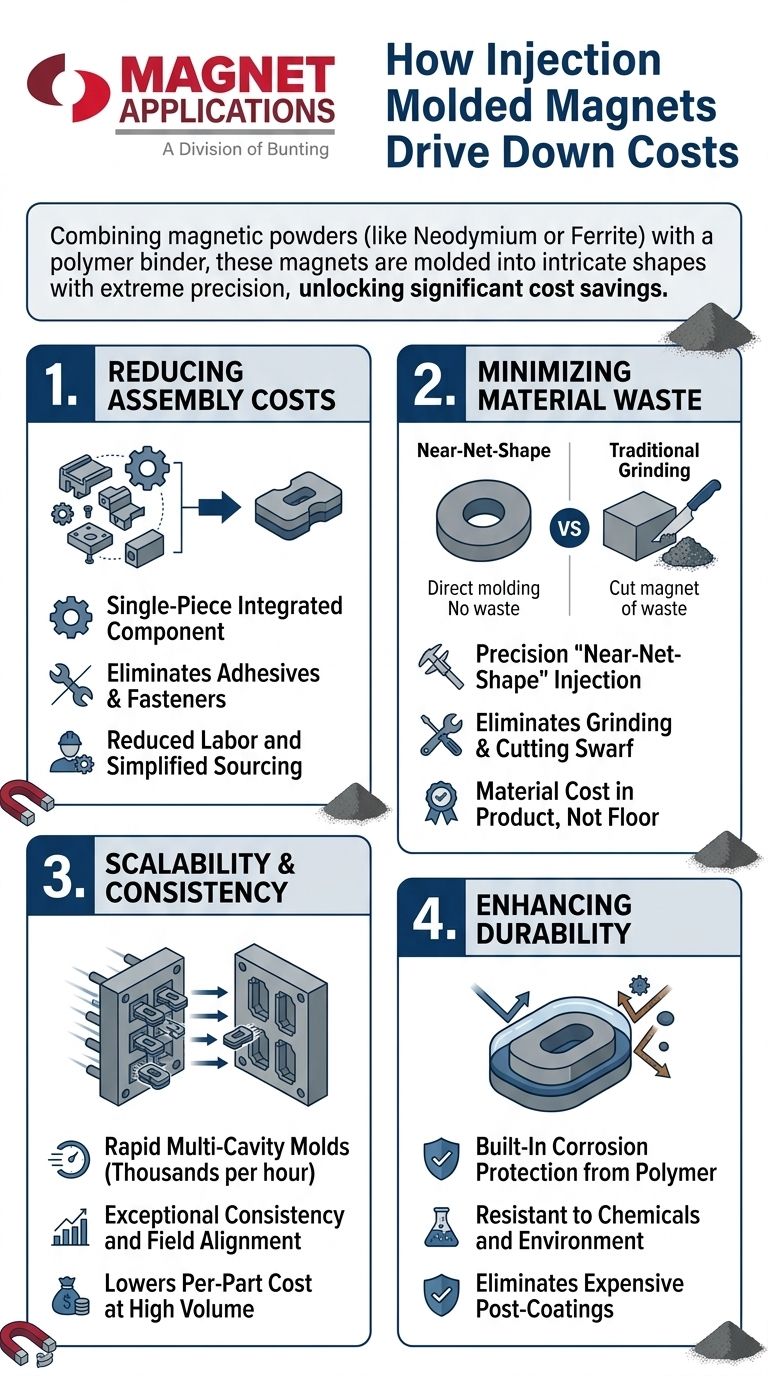
By combining magnetic powders (like Neodymium or Ferrite) with a polymer binder, Injection Molded Magnets can be molded into intricate shapes with extreme precision, just like plastic parts. This process unlocks several layers of cost savings.
1. Drastically Reducing Assembly Costs Through Part Consolidation
The single greatest cost benefit comes from simplifying complex assemblies. Because of their unique manufacturing process, Injection Molded Magnets can incorporate features that other magnets cannot.
- Insert and Over-Molding: Magnets can be molded directly onto or around other components like shafts, housings, or lead frames. This creates a single, integrated component, eliminating the need for adhesives, fasteners, and the labor required to assemble them. For a magnetic sensing system, this means the sensor's magnetic ring and its mounting hub can become one piece.
2. Minimizing Material Waste with Near-Net-Shape Manufacturing
Traditional sintered magnets are produced in blocks and then cut or ground down to the final shape. This process is not only slow but also creates significant material waste, and the magnetic powder "swarf" is difficult and costly to reclaim.
- The Injection Molding Advantage: Injection Molded Magnets are a "near-net-shape" technology. The precise amount of the magnetic polymer mixture is injected into a mold to create the final part. There is virtually no post-processing or grinding required, which means you pay for the material in your product, not the material on the factory floor.
3. Achieving Scalability and Consistency at Speed
To be cost-effective, large-scale production demands speed and repeatability. The injection molding process is borrowed from the high-volume plastics industry and is inherently fast.
- Rapid Cycle Times: Multi-cavity molds can produce thousands of identical parts per hour. This high-speed production dramatically lowers the per-part cost, making Injection Molded Magnets the ideal choice for production runs in the hundreds of thousands or millions.
- Tight Tolerances: The process delivers exceptional consistency and tight tolerances from the first part to the last. For magnetic sensing systems that rely on exact alignment and a consistent magnetic field, this reliability eliminates costly quality control issues down the line.
4. Enhancing Durability and Reducing Post-Processing
The polymer binder used in Injection Molded Magnets does more than just hold the magnetic particles together; it also provides inherent protection.
- Built-In Corrosion Resistance: The polymer matrix encapsulates the magnetic particles, offering excellent resistance to corrosion and common chemicals. This often eliminates the need for expensive secondary coatings (like nickel or epoxy) that are required for many sintered magnets, saving both time and money.
A Practical Breakdown: Key Cost-Saving Benefits
Here is a scannable summary of how Injection Molded Magnets reduce costs in the production of magnetic sensing systems:
- Consolidate Parts: Merge magnets with shafts, gears, or housings into a single unit to eliminate assembly labor and adhesive costs.
- Eliminate Waste: Utilize near-net-shape manufacturing that minimizes the waste of expensive magnetic materials.
- Accelerate Production: Leverage rapid cycle times to produce millions of parts quickly and lower the cost per unit.
- Improve Consistency: Maintain tight tolerances across massive production runs, reducing rejects and ensuring reliable sensor performance.
- Remove Secondary Steps: Rely on the inherent corrosion resistance of the polymer binder to avoid the expense of protective coatings.
Choosing the Right Partner for Injection Molded Magnet Solutions
To fully realize these cost benefits, it is crucial to work with an experienced manufacturing partner. A full-service provider like Magnet Applications, a Bunting brand, offers turnkey services that cover everything from material selection and engineering design to high-volume manufacturing and quality assurance.
With U.S.-based, ISO 9001:2015 certified facilities, they provide the expertise needed to design complex shapes and over-molded components that maximize efficiency. Their deep knowledge of materials—from cost-effective Ferrite to high-strength Neodymium-Iron-Boron (NdFeB)—ensures your magnetic sensing system is optimized for both performance and price.
Final Thoughts
For decision-makers in high-volume manufacturing, the choice of magnetic material is a critical financial decision. Injection Molded Magnets are not just a component; they are a strategic tool for redesigning production processes. By reducing assembly complexity, eliminating waste, and enabling high-speed scalability, they provide a clear and compelling path to a lower total cost of production for advanced magnetic sensing systems.
Frequently Asked Questions
How do injection molded magnets reduce manufacturing costs?
Injection molded magnets reduce costs in several key ways: by consolidating multiple parts into a single component through over-molding, which cuts assembly labor; by using a near-net-shape process that minimizes expensive material waste; by enabling rapid, high-volume production with fast cycle times; and by eliminating the need for costly secondary processes like protective coatings.
Why are injection molded magnets ideal for high-volume production?
Their suitability for high-volume production comes from the injection molding process itself, which is inherently fast and repeatable. Multi-cavity molds can produce thousands of identical parts per hour with tight tolerances, ensuring consistency across massive production runs and significantly lowering the cost per unit.
What are injection molded magnets?
Injection molded magnets are composite materials created by combining magnetic powders, such as Neodymium or Ferrite, with a polymer binder. This mixture allows them to be molded into complex and precise shapes, similar to standard plastic parts.
Do injection molded magnets require protective coatings?
No, they often do not. The polymer binder used in their construction encapsulates the magnetic particles, providing inherent resistance to corrosion and chemicals. This eliminates the need for expensive secondary coatings that are typically required for traditional sintered magnets.