

To ensure reliability in encoders, you must test bonded magnets for magnetic performance, mechanical integrity, and environmental stability under application-specific conditions. Datasheet values alone are insufficient due to the unique failure modes of their polymer binder matrix.
This approach prevents performance drift and premature failure in critical systems.
What You'll Learn
- Why Standard Testing Fails: Understand why the composite nature of bonded magnets (magnetic powder in a polymer binder) creates unique failure points that standard datasheets don't capture.
- Core Testing Protocols: A breakdown of the four essential testing practices: magnetic verification, environmental stress testing, mechanical fatigue analysis, and combined stressor simulation.
- The "Failure Masquerade": Learn why bonded magnet failures often present as electronic issues like sensor drift or calibration errors, leading to costly misdiagnosis.
- Essential Measurement Tools: A quick-reference list of the equipment needed for accurate and reliable testing.
Why Standard Testing Isn't Enough for Bonded Magnets
Encoders demand precision and stability. While bonded magnets offer incredible geometric flexibility—allowing for complex shapes ideal for compact encoder designs—their performance is fundamentally tied to a polymer binder matrix. This composite structure introduces failure modes completely different from their solid, sintered counterparts.
The core issue is the binder (like epoxy, nylon, or PPS). It's the limiting factor for temperature, environmental resistance, and long-term mechanical stability. When the binder is compromised, the magnet's performance degrades in ways that often masquerade as other system problems. This is known as the "Failure Masquerade Pattern"—what appears to be electronic sensor drift is often a physical change in the magnet itself.
Therefore, relying solely on a manufacturer's datasheet is a risk. Best practices require testing that simulates the magnet's actual operating environment.
Core Testing Best Practices for Encoder Magnets
To guarantee the reliability of an encoder, testing must go beyond simple magnetic field measurements. It needs to address the vulnerabilities of the bonded magnet's construction.
1. Magnetic Performance Verification (Beyond the Datasheet)
While datasheets provide a baseline, you must verify performance to ensure batch-to-batch consistency. The polymer binder displaces magnetic material, so even small variations in the manufacturing process can affect output.
- Key Parameters to Test:
- Maximum Energy Product (BHmax): Confirms the magnet's overall strength. Bonded magnets typically operate in the 5–10 MGOe range, significantly lower than sintered magnets, so there is less room for error.
- Coercivity (Hcj): Measures the magnet's resistance to demagnetization. Bonded magnets have lower coercivity, making them more susceptible to performance loss from reverse fields or high temperatures.
- Flux Density Consistency: Map the magnetic field across the magnet's surface to ensure uniformity, which is critical for the encoder's positional accuracy.
2. Environmental and Thermal Stress Testing
This is arguably the most critical testing phase for bonded magnets, as the polymer binder is highly sensitive to its environment.
- Thermal Cycling: A magnet's true temperature ceiling is its binder's glass transition temperature (Tg). Exceeding this causes the polymer to soften, leading to dimensional shifts. In an encoder, this changes the air gap between the magnet and the sensor, presenting as calibration drift (a Class A failure).
- How to Test: Cycle the magnet between its minimum and maximum expected operating temperatures for hundreds or thousands of cycles, measuring for any change in magnetic output or physical dimensions. For high-temperature applications, PPS-bonded systems (stable up to ~175 °C) offer superior performance over nylon or epoxy.
- Moisture and Chemical Exposure: Many binders are susceptible to moisture, which can be catastrophic for long-term stability.
- Why it Matters: Nylon binders are hydrophilic and will absorb moisture, causing them to swell (a Class C failure). This swelling introduces internal stress at the particle-matrix interface, leading to micro-cracks and a gradual, irreversible loss of magnetic performance over the device's lifetime.
- How to Test: Submerge or expose the magnet to the humidity, liquids, or chemicals present in its target environment for an extended period, monitoring for physical swelling or flux degradation.
3. Mechanical Integrity and Fatigue Testing
Encoders used in automotive, aerospace, or industrial applications are often exposed to constant vibration and shock.
- Vulnerability Point: The bond between the magnetic powder and the polymer matrix is the weakest link. Repeated flexing or high-G impacts can initiate micro-cracks at this interface (a Class B failure). These cracks are not visible externally but will eventually connect, causing a sudden loss of magnetic field.
- How to Test: Use vibration tables and shock test equipment that mimic the application's mechanical stresses. Perform magnetic measurements before and after to detect any degradation in performance, as this indicates internal damage.
4. Combined Stressor Simulation (The Class E Test)
The most dangerous failures occur when multiple stressors are present simultaneously—a situation that datasheets never account for. This is known as a Class E, or Combined Stressor, failure.
- Real-World Scenarios:
- An automotive sensor experiencing engine heat, vibration, and exposure to cleaning chemicals.
- A marine encoder facing constant saltwater spray, low temperatures, and hydrostatic pressure.
- The Best Practice: The gold standard is to create a test protocol that simulates the combined environmental factors of the final application. This is the only way to reliably predict the long-term performance of bonded magnets in demanding roles. For any critical application, application-specific testing is not optional; it is required.
Essential Tools for Accurate Magnet Testing
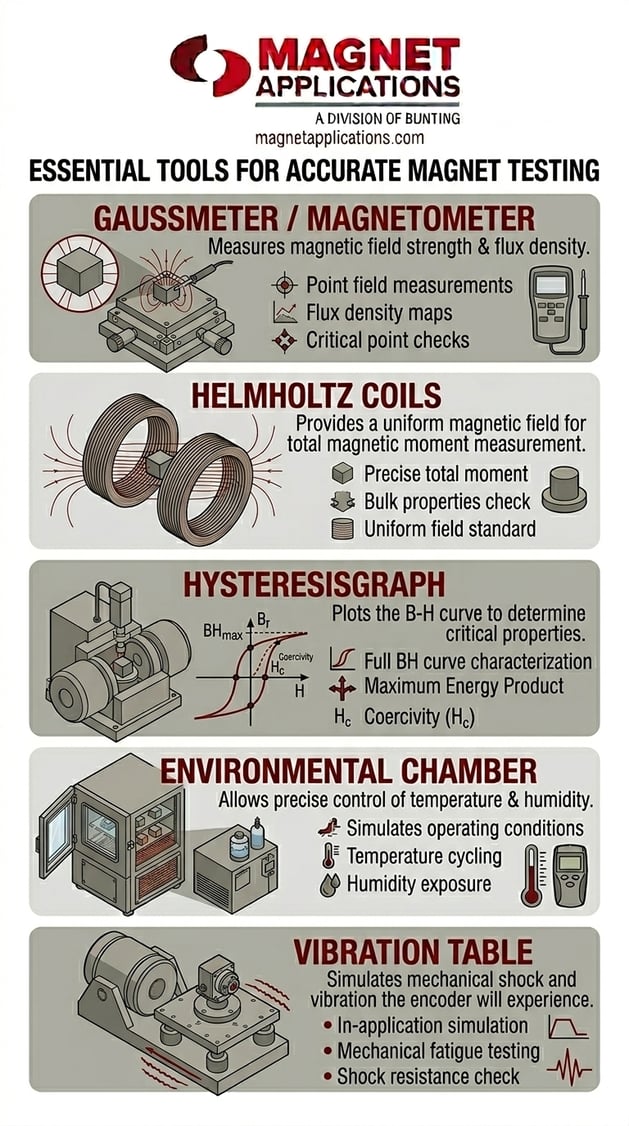
Performing these tests requires specialized equipment. Here are the key instruments for a comprehensive evaluation:
- Gaussmeter / Magnetometer: Measures magnetic field strength and flux density at specific points.
- Helmholtz Coils: Provides a uniform magnetic field for precisely measuring a magnet's total magnetic moment.
- Hysteresisgraph: Plots the B-H curve to determine critical properties like BHmax and Coercivity.
- Environmental Chamber: Allows for precise control of temperature and humidity to simulate operating conditions.
- Vibration Table: Simulates the mechanical shock and vibration the encoder will experience in its application.
The Payoff: Why Rigorous Testing Matters
Thoroughly testing bonded magnets for your specific encoder application isn't an extra step—it's a core part of ensuring system reliability. By moving beyond the datasheet and testing for real-world conditions, you:
- Prevent Unforeseen Failures: Catch vulnerabilities before they lead to field failures.
- Avoid Costly Misdiagnosis: Stop chasing "electronic drift" or "sensor noise" when the root cause is magnet degradation.
- Ensure Long-Term Reliability: Guarantee that the encoder will perform as expected for its entire service life, especially in applications where failure is not an option.
In short, the geometric flexibility of bonded magnets is a powerful design tool, but it comes with the responsibility of rigorous, application-specific testing. This is the definitive best practice for any engineer aiming for high-quality, reliable performance.
Frequently Asked Questions
Why can't I just rely on a bonded magnet's datasheet?
Datasheets are insufficient because a bonded magnet's polymer binder creates unique failure modes related to temperature, environment, and mechanical stress that datasheets don't capture. The binder's degradation under real-world conditions is the primary cause of unforeseen performance loss, which often masquerades as an electronic issue.
What are the most critical tests for ensuring bonded magnet reliability?
The four essential tests are: 1) Magnetic Performance Verification to confirm strength and consistency; 2) Environmental and Thermal Stress Testing to evaluate the binder's stability against heat and moisture; 3) Mechanical Integrity Testing for resistance to vibration and shock; and 4) Combined Stressor Simulation to replicate real-world operating conditions.
What is the "Failure Masquerade Pattern" in encoders?
The "Failure Masquerade Pattern" is when a physical degradation of the bonded magnet (like swelling from moisture or a dimensional shift from heat) is misdiagnosed as an electronic problem, such as sensor drift or calibration errors. The root cause is the magnet, not the electronics.