
Compression bonded magnets are exceptionally well-suited for customization in automotive applications. They can be precisely tailored in terms of complex shapes, sizes, magnetic and physical properties, plus protective coatings to meet the specific performance, space, and environmental demands of modern vehicles.
What You'll Learn
This article provides a definitive guide to customizing compression bonded magnets for the automotive sector. Here’s a quick overview of what we'll cover:
- The Three Pillars of Customization: How shape, magnetic properties, and coatings are modified.
- Key Benefits for Automotive Engineers: Why customization with these magnets leads to better efficiency and lower costs.
- Specific Automotive Use Cases: Real-world examples where tailored magnets are essential.
- The Manufacturing Process: How a capable partner turns a design into a finished component.
The Core of Customization: What Can Be Tailored?

The value of Compression Bonded Magnets lies in their inherent flexibility. Unlike sintered magnets, which are rigid and difficult to shape, the compression bonding process allows for a high degree of engineering freedom. While sintered magnets are brittle and prone to damage, compression-bonded magnets are naturally more durable and resistant to chipping or cracking.
Complex Shapes and Precise Sizing
The manufacturing process involves pressing a mix of NdFeB magnetic powder and a resin binder into a mold. This allows for the creation of components "to net shape," meaning they require no costly or wasteful secondary machining.
For automotive applications where space is at a premium, this is a critical advantage. Engineers can design:
- Thin-walled rings for compact sensors and encoders.
- Complex arc segments for fractional horsepower motors.
- Intricate geometries with high dimensional precision to fit perfectly within complex assemblies.
Tunable Magnetic Properties and Multi-Pole Magnetization
Compression Bonded Magnets are isotropic, meaning they can be magnetized in any direction after they are formed. This unlocks a level of customization impossible with many other materials, as well as being very cost effective.
Engineers can specify complex, multi-pole magnetization patterns on a single magnetic face. This is essential for applications like rotary encoders and brushless DC motors, which rely on precise magnetic fields for accurate feedback and efficient operation. Furthermore, various material grades are available (from B10N to SB30), allowing designers to select the optimal balance of magnetic strength (remanence) and performance for their specific application.
Application-Specific Protective Coatings
The automotive environment can be harsh, with exposure to humidity, temperature fluctuations, and corrosive agents. To ensure long-term reliability, Compression Bonded Magnets can be customized with protective coatings like epoxy or Parylene, which shield the magnet from environmental degradation.
Why Choose Compression Bonded Magnets for Automotive Customization?
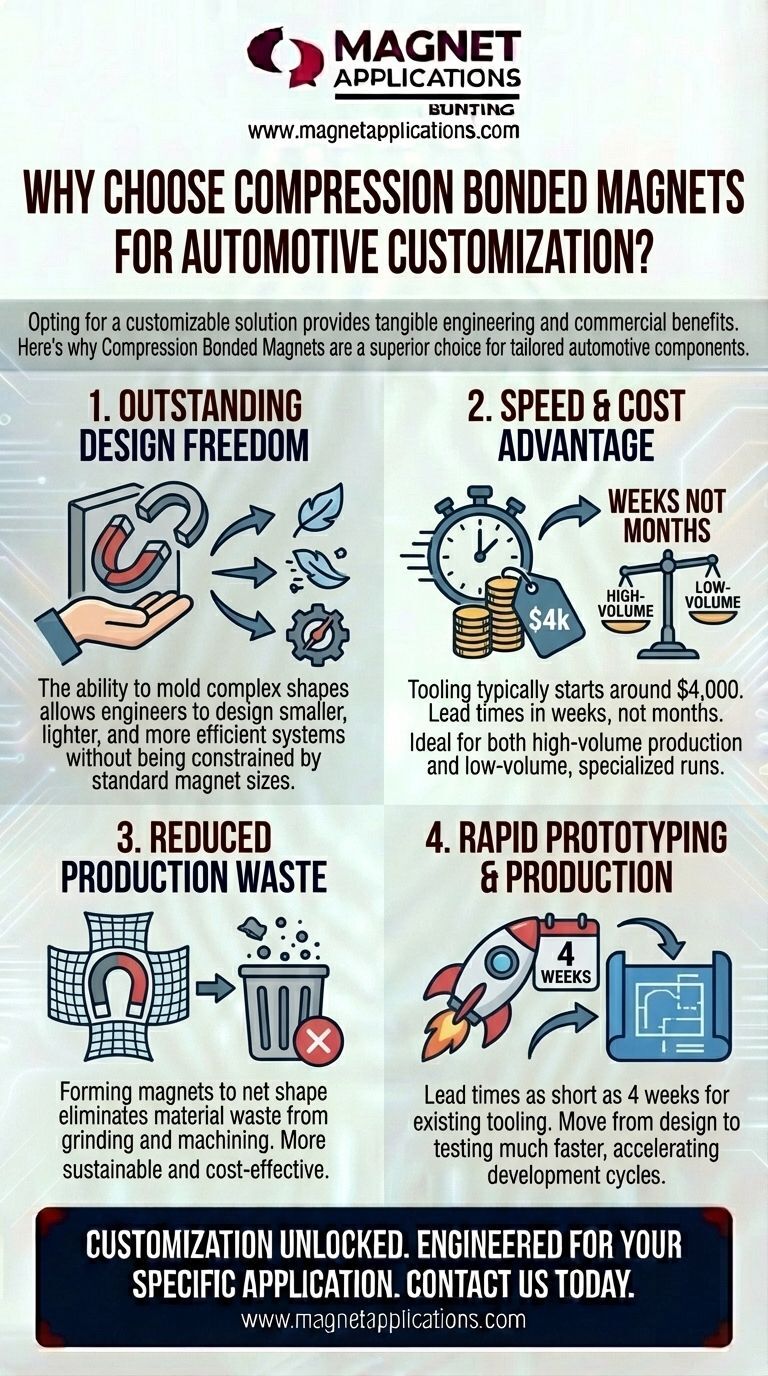
Opting for a customizable solution provides tangible engineering and commercial benefits. Here’s why Compression Bonded Magnets are a superior choice for tailored automotive components.
- Outstanding Design Freedom: The ability to mold complex shapes allows engineers to design smaller, lighter, and more efficient systems without being constrained by standard magnet sizes.
- Compression bonding offers a significant advantage in speed and cost: tooling typically starts around $4,000, far lower than injection molding, and lead times are measured in weeks rather than months. This efficiency makes it an ideal solution for both high-volume production and low-volume, specialized runs.
- Reduced Production Waste: Forming magnets to net shape eliminates the material waste associated with grinding and machining sintered magnets, leading to a more sustainable and cost-effective process.
- Rapid Prototyping and Production: With lead times as short as 4 weeks for existing tooling, engineers can move from design to testing much faster, accelerating development cycles.
Real-World Automotive Applications for Customized Magnets
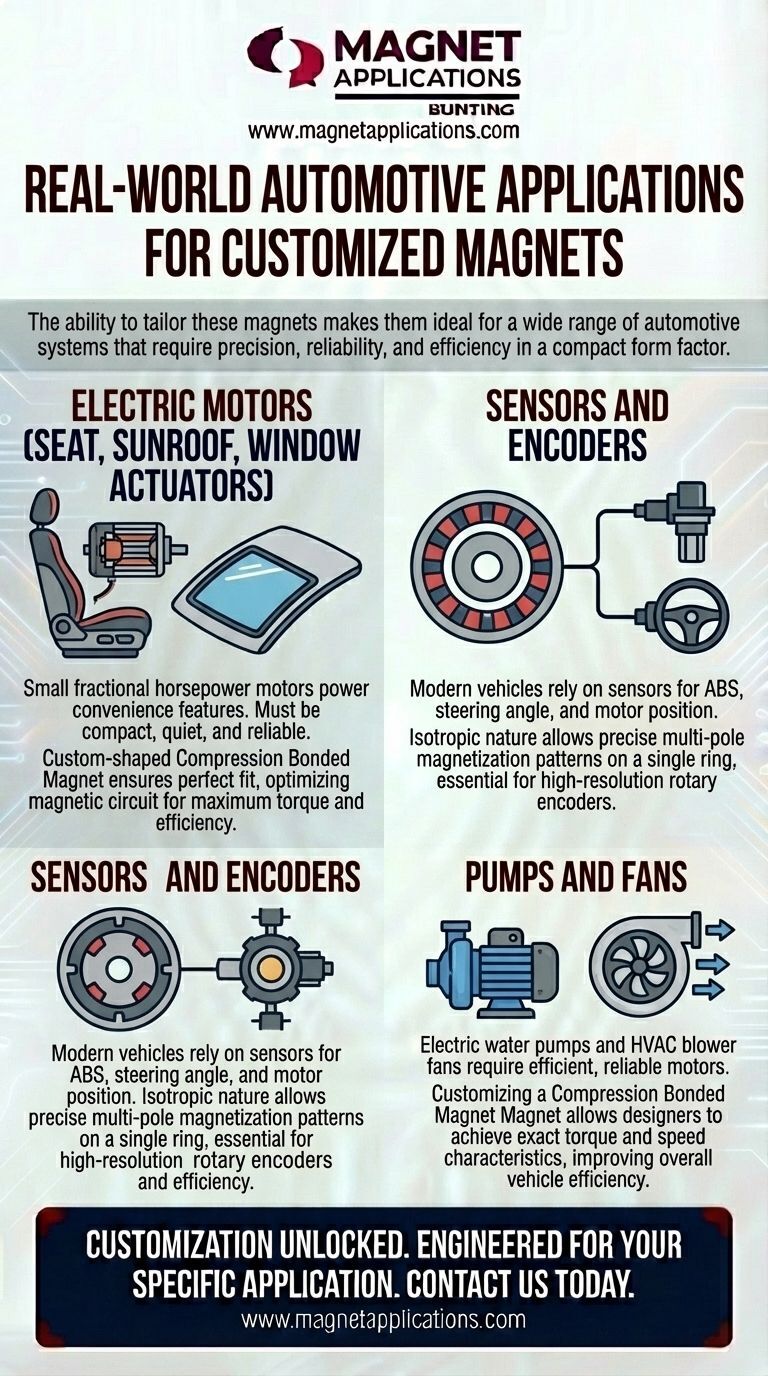
The ability to tailor these magnets makes them ideal for a wide range of automotive systems that require precision, reliability, and efficiency in a compact form factor.
Electric Motors (Seat, Sunroof, and Window Actuators)
Small fractional horsepower motors power numerous convenience features in a vehicle. These motors must be compact, quiet, and reliable. A custom-shaped Compression Bonded Magnet ensures a perfect fit within the motor housing, optimizing the magnetic circuit for maximum torque and efficiency in the smallest possible package.
Sensors and Encoders
Modern vehicles rely on dozens of sensors for everything from anti-lock braking systems (ABS) to steering angle and motor position feedback. Compression Bonded Magnets are perfect for these applications because their isotropic nature allows for precise multi-pole magnetization patterns on a single ring, which is essential for high-resolution rotary encoders.
Pumps and Fans
Components like electric water pumps and HVAC blower fans require efficient and reliable motors. Customizing a Compression Bonded Magnet for these applications allows designers to achieve the exact torque and speed characteristics needed, improving overall vehicle efficiency and performance.
The Manufacturing Advantage: From Design to Delivery
True customization goes beyond the magnet itself. Choosing a manufacturing partner who controls the entire process—from powder processing and tooling to magnetization and quality assurance—is critical for success. From design conception and initial engineering consultations to full-scale production, Magnet Applications handles every stage of your project directly from our manufacturing facility in DuBois, Pennsylvania.
A vertically integrated supplier can offer end-to-end services, including:
- In-house tooling development to create precise molds for your unique design.
- Custom magnetizing fixtures to achieve complex multi-pole patterns.
- PPAP documentation (Levels 1-3) to meet stringent automotive quality standards.
- Inventory management programs to support Just-in-Time (JIT) delivery schedules.
This level of control ensures that the final component not only meets design specifications but is also delivered on time and backed by a fully traceable, domestic supply chain—a crucial consideration in today's global market.
A Tailor-Made Solution for Modern Automotive Needs
In summary, Compression Bonded Magnets produced by Magnet Applications are not just a component – they are an adaptable engineering solution. As the only US manufacturer of these materials they are not subject to international disrupting events. Their inherent customizability in shape, magnetic profile, and durability makes them a powerful tool for automotive engineers striving to build the next generation of efficient, reliable, and compact vehicle systems.
Frequently Asked Questions
What aspects of compression bonded magnets can be customized?
Compression bonded magnets can be customized in three key areas: their shape and size (e.g., thin-walled rings, complex arcs), their magnetic properties (including multi-pole magnetization patterns and strength), and the application of protective coatings like epoxy to enhance durability in harsh automotive environments.
Why are compression bonded magnets cost-effective for automotive manufacturing?
They are cost-effective due to significantly lower tooling costs compared to injection molding, the elimination of material waste by forming magnets "to net shape," and faster production lead times (as short as 4 weeks) which accelerate development cycles and reduce costs.
What are common automotive applications for customized compression bonded magnets?
Common automotive applications include small electric motors for seat, sunroof, and window actuators; high-precision sensors and encoders for systems like anti-lock braking (ABS) and steering angle feedback; and components for electric water pumps and HVAC blower fans.