

Bonded magnets in drones offer excellent thermal stability, with performance ceilings up to 175°C using advanced binders. Their ability to withstand rapid heating and cooling cycles is critical for maintaining motor efficiency, thrust, and the overall durability of the drone during demanding flights.
What You'll Learn
This article provides a clear, engineer-focused breakdown of the thermal properties of bonded magnets for drone applications. Here’s a summary of what we’ll cover:
- The critical role of thermal stability in drone motor performance and longevity.
- Key thermal properties and specific temperature limits of modern bonded magnets.
- How binder materials (like Nylon and PPS) define a magnet's thermal capabilities.
- The unique thermal challenges created by drone flight cycles (climb, hover, descent).
- Why Electric Motors - Bonded Magnets are engineered to solve these challenges.
Why Thermal Stability is Critical for Drone Motors
In a high-performance drone, the propulsion motors operate under immense stress. They rapidly change speed to provide lift, stability, and maneuverability. This constant work generates significant heat within the motor's core components, including its permanent magnets.
Thermal stability isn't just a datasheet metric; it directly impacts real-world performance. A magnet that loses its magnetic properties (flux) when hot causes the motor to become less efficient. This forces the system to draw more current to produce the same amount of thrust, leading to shorter flight times and potentially overheating other electronic components. For R&D engineers, understanding and specifying magnets with reliable thermal properties is fundamental to designing a durable and high-performance drone.
Core Thermal Properties of Electric Motors - Bonded Magnets
The thermal behavior of a bonded magnet is primarily determined by its binder—the polymer matrix that holds the magnetic powder together. This is where Electric Motors - Bonded Magnets excel, offering tailored solutions for specific operating environments.
Operating Temperature Limits
The binder sets the thermal ceiling. A magnet can only perform reliably up to the temperature its binder can withstand.
- Nylon (PA12) Binders: Commonly used for their low cost and excellent moldability, these are suitable for operating temperatures up to 80–120°C. This range covers many consumer and prosumer drone applications.
- PPS (Polyphenylene Sulfide) Binders: This advanced binder is the choice for high-performance and commercial drone applications. It pushes the thermal ceiling to approximately 175°C. Research confirms that PPS-bonded magnets show only a 2.35% flux loss after 1,000 hours at this temperature, demonstrating exceptional stability under extreme conditions.
Thermal Cycling and Performance
Drone flight is not a steady state. A typical flight involves a high-power climb (generating heat), a hover or cruise period, and a descent (allowing for cooling). This rapid thermal cycling is a major stressor.
Electric Motors - Bonded Magnets are engineered to withstand these repeated temperature swings. Their composition ensures dimensional stability, preventing micro-fractures or "thermal creep," where the magnet could physically shift on the rotor over hundreds of flight cycles. This stability is key to preventing vibration and maintaining motor balance over the drone's entire service life.
Demagnetization Risk at High Temperatures
A magnet's resistance to being demagnetized (its coercivity) decreases as its temperature increases. A drone motor can experience fault currents from its controller, creating a strong demagnetizing field. The combination of a high operating temperature and a fault current event can permanently weaken a magnet.
Because bonded magnets have inherently lower coercivity than their sintered counterparts, selecting a high-grade product like Electric Motors - Bonded Magnets with a thermally robust binder is crucial for mitigating this risk.
How Bonded Magnets Address Drone-Specific Challenges
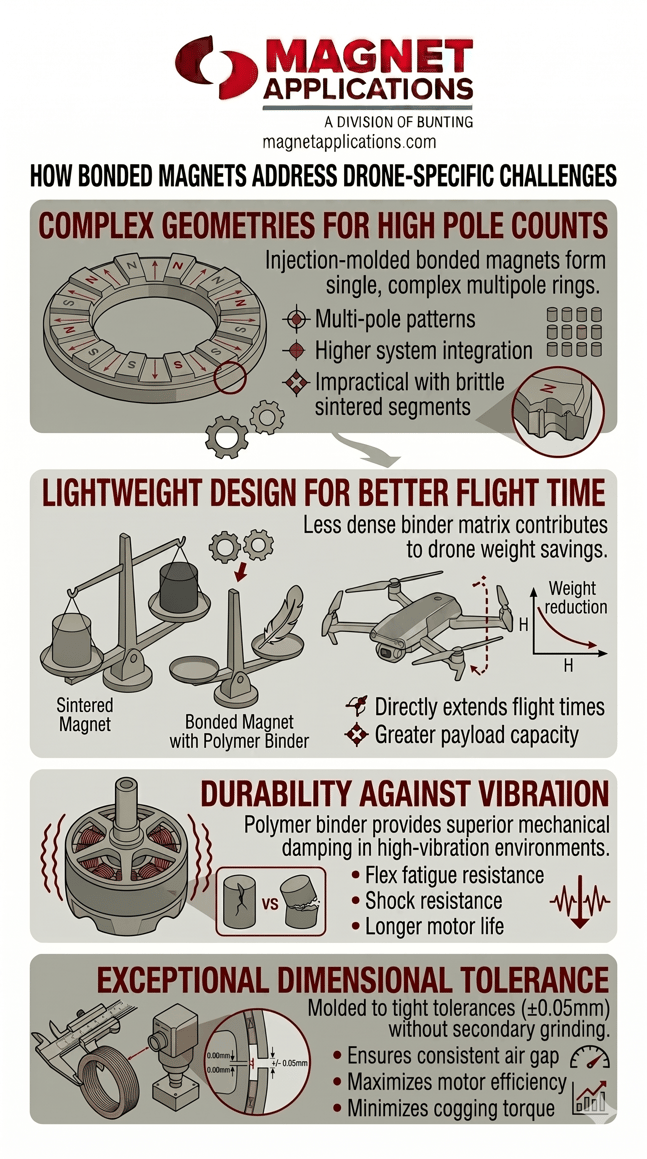
Drones present a unique set of engineering constraints: high power, low weight, and complex geometry. Sintered magnets often cannot meet these needs, making bonded magnets the ideal solution.
Here’s how Electric Motors - Bonded Magnets are specifically suited for drone propulsion systems:
- Complex Geometries for High Pole Counts: Drone motors use a high pole count (often 14-24 poles) to achieve smooth, efficient operation. Injection-molded bonded magnets can be formed into single, complex multipole rings, a feat that is impractical or impossible with brittle sintered segments at this scale.
- Lightweight Design for Better Flight Time: The binder matrix makes bonded magnets less dense than fully dense sintered magnets. This weight savings is critical in drone design, directly contributing to longer flight times and greater payload capacity.
- Durability Against Vibration: A drone motor is a high-vibration environment due to propeller dynamics and air turbulence. The polymer binder in Electric Motors - Bonded Magnets provides superior mechanical damping compared to brittle sintered magnets, improving resistance to flex fatigue and shock.
- Exceptional Dimensional Tolerance: Bonded magnets can be molded to tight tolerances (±0.05mm) without secondary grinding. This precision ensures a consistent air gap between the rotor and stator, which is essential for maximizing motor efficiency and minimizing cogging torque.
Conclusion: The Engineering Advantage for Drones
For engineers designing high-performance drones, the choice of magnet is fundamental. While raw magnetic strength is important, thermal stability under dynamic conditions is what ensures reliability and sustained performance.
Electric Motors - Bonded Magnets provide the ideal combination of properties required for this demanding application. Their high-temperature PPS binder options, ability to be molded into complex and lightweight multipole rings, and inherent resilience to thermal cycling make them the superior engineering choice for pushing the boundaries of drone flight.
Frequently Asked Questions
What determines the maximum operating temperature of a bonded magnet?
The maximum operating temperature, or thermal ceiling, of a bonded magnet is primarily determined by its binder material. This polymer matrix holds the magnetic powder together and dictates how much heat the magnet can reliably withstand. For example, Nylon binders are suitable for lower temperatures, while PPS binders allow for much higher operating temperatures.
What are the typical temperature limits for bonded magnets used in drones?
The temperature limits vary by binder type. Bonded magnets with Nylon (PA12) binders are suitable for operating temperatures up to 80–120°C, covering many consumer and prosumer drones. For high-performance and commercial drones, magnets with advanced PPS (Polyphenylene Sulfide) binders are used, pushing the thermal ceiling to approximately 175°C.
Why are bonded magnets ideal for high-performance drone motors?
Bonded magnets are ideal for drone motors because they can be injection-molded into complex, single-piece multipole rings required for smooth and efficient operation. They are also less dense than sintered magnets, which reduces weight and increases flight time. Furthermore, their polymer binder provides superior mechanical damping, making them more durable against the vibration and shock common in drone flight.