

In 2026, advancements in injection molded magnets are driven by high-temperature polymers and micro-molding techniques. These innovations create more durable, precise, and compact magnetic components, significantly enhancing Hall effect sensor accuracy and reliability in demanding applications like automotive and consumer electronics.
What You'll Learn
This article breaks down the cutting-edge trends shaping the future of magnetic sensing. Here’s a summary of the key advancements we'll cover:
- High-Performance Polymer Binders: The development of new polymers that withstand extreme temperatures and allow for higher magnetic particle loading.
- Micro-Molding for Miniaturization: The ability to manufacture incredibly small and complex magnets, essential for modern compact devices.
- Complex Multi-Pole Magnetization: Techniques for creating intricate magnetic fields on a single component to improve sensor resolution and functionality.
- Integrated Over-Molded Assemblies: Combining the magnet, housing, and other components into a single, robust part during the molding process.
Why Hall Effect Sensors Demand Better Magnets
Hall effect sensors are the unsung heroes in countless systems, detecting the position, speed, and direction of moving parts. From antilock braking systems in cars to brushless DC motors in drones, their accuracy is paramount. As technology gets smaller, faster, and more efficient, the magnets that activate these sensors must evolve.
Standard magnets often present design limitations—they are brittle, restricted to simple shapes, and can be difficult to integrate into complex assemblies. This is where the unique properties of Injection Molded Magnets become critical.
Key Advancements in Injection Molded Magnets for 2026
Engineers are leveraging new material and manufacturing breakthroughs to push the boundaries of what's possible. Here are the four advancements making the biggest impact.
Advancement #1: High-Performance Polymer Binders
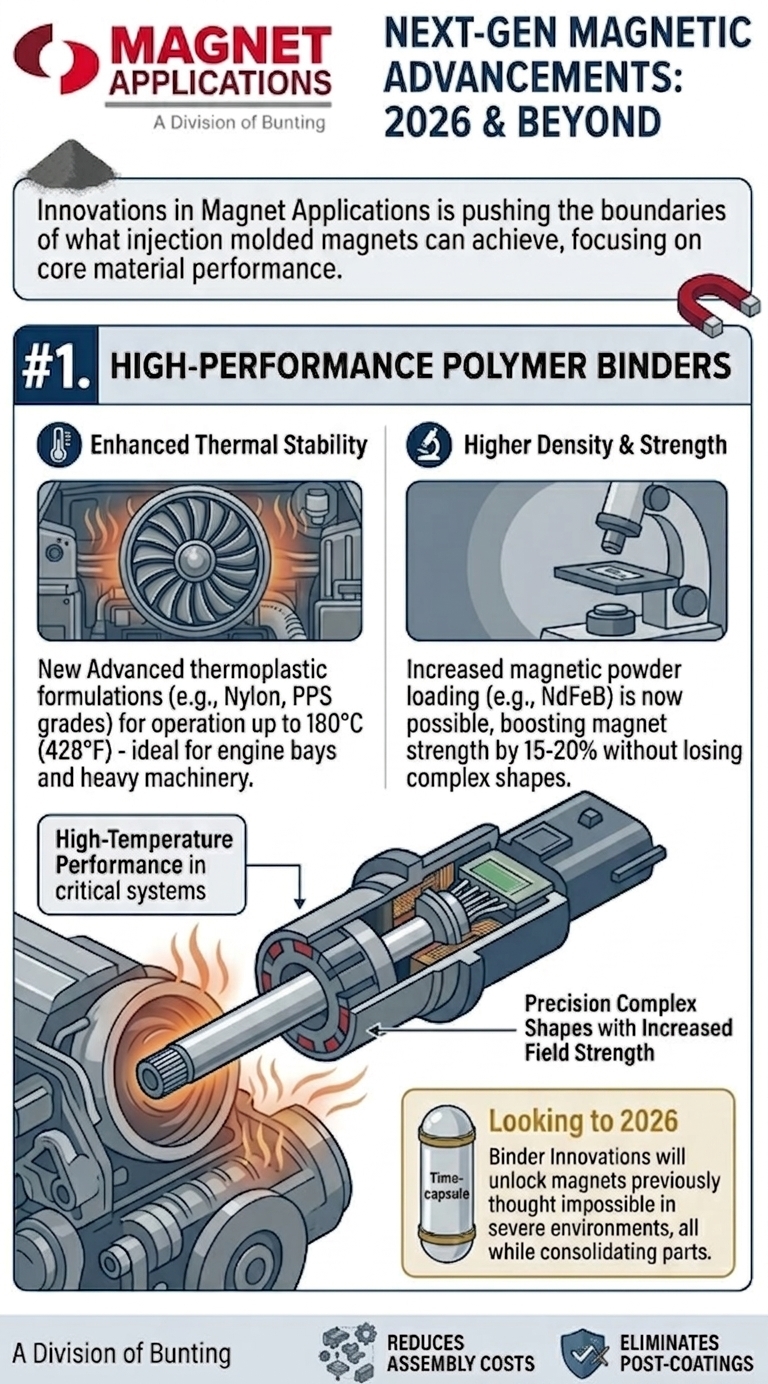
The performance of an injection molded magnet depends heavily on its two core ingredients: the magnetic powder and the polymer binder that holds it together. By 2026, the focus has shifted significantly to the binder.
New thermoplastic formulations, such as advanced grades of Nylon and Polyphenylene Sulfide (PPS), offer superior thermal stability. This allows Hall effect sensors to operate reliably in high-heat environments like engine bays or industrial machinery without magnetic degradation. Furthermore, these advanced polymers enable a higher-density loading of magnetic powders like Neodymium-Iron-Boron (NdFeB), boosting the magnet's overall strength without sacrificing its complex shape.
Advancement #2: The Rise of Micro-Molding
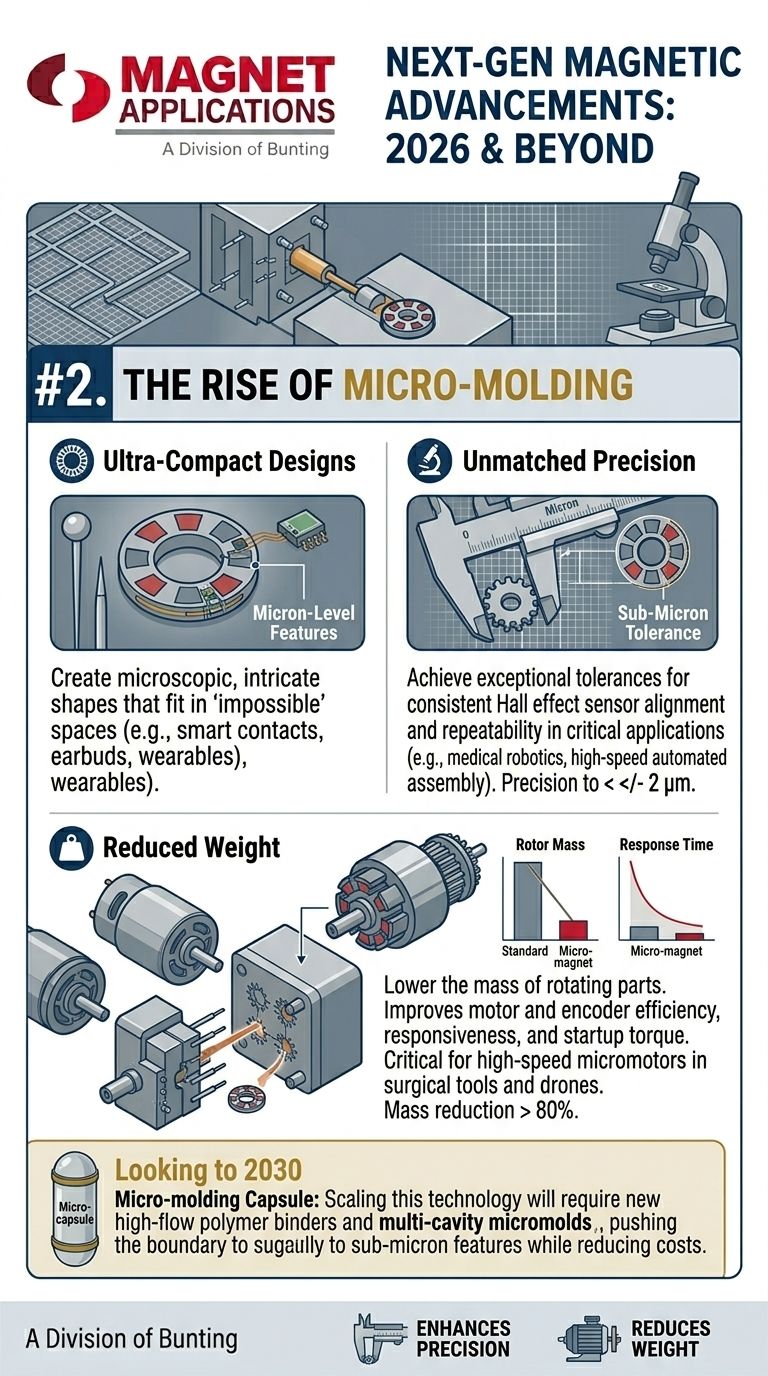
As devices shrink, so must their components. The trend of miniaturization in medical wearables, IoT devices, and automotive micro-sensors has fueled the need for microscopic magnetic parts.
Micro-molding is an evolution of the injection molding process that produces components with features measured in microns. For Hall effect sensors, this means:
- Ultra-Compact Designs: Creating tiny, intricate magnets that fit into previously impossible spaces.
- Unmatched Precision: Achieving exceptionally tight tolerances for consistent sensor activation and repeatability.
- Reduced Weight: Lowering the mass of rotating components, which improves efficiency and response time in motors and encoders.
Advancement #3: Complex Multi-Pole Magnetization
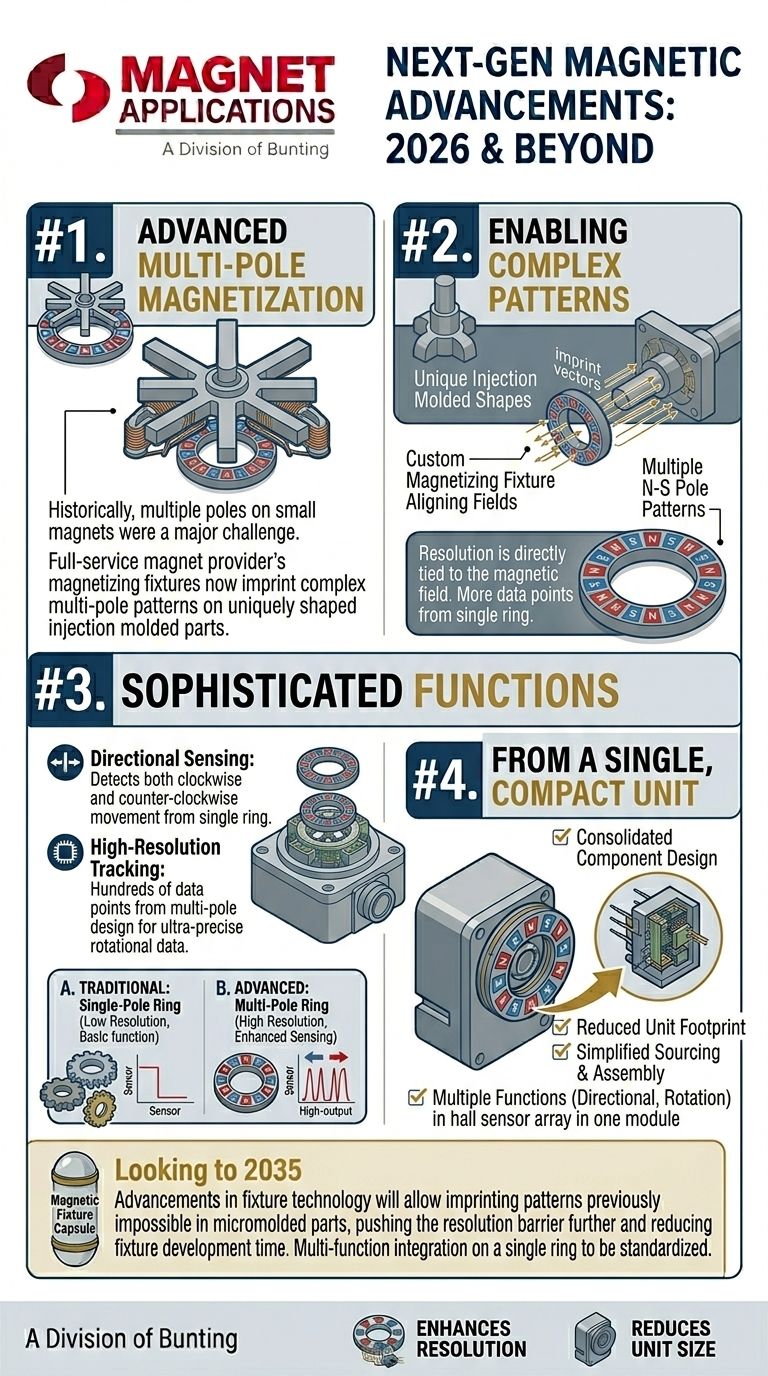
A Hall effect sensor's resolution is directly tied to the magnetic field it measures. Historically, creating multiple magnetic poles (North and South) on a single, small magnet was a major challenge.
Today, advanced magnetizing fixtures, often developed by full-service magnet providers, can imprint complex multi-pole patterns onto uniquely shaped injection molded parts. This allows a single magnetic ring or component to provide multiple points of data for a sensor, enabling more sophisticated functions like directional sensing and high-resolution rotational tracking from a single, compact unit.
Advancement #4: Integrated Over-Molded Assemblies
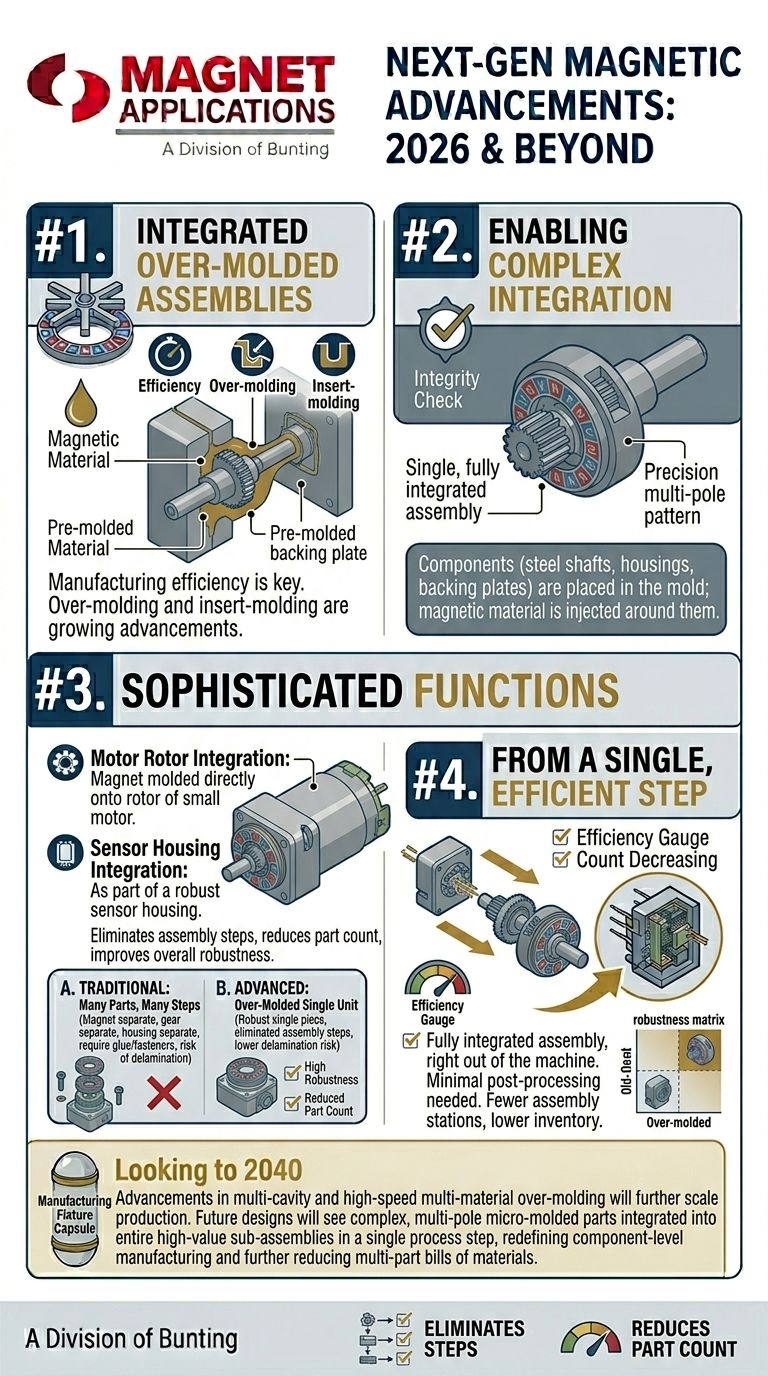
Efficiency in manufacturing is key. One of the most significant advancements is the growing use of over-molding and insert-molding. This process involves placing other components (like a steel shaft, a plastic housing, or a backing plate) directly into the mold and injecting the magnetic material around it.
This creates a single, fully integrated assembly right out of the machine. An Injection Molded Magnet can be molded directly onto the rotor of a small motor or as part of a sensor housing, eliminating assembly steps, reducing part count, and improving the overall robustness of the final product.
How These Advancements Benefit Hall Effect Sensor Applications
These innovations translate directly into tangible benefits across various industries. By leveraging advanced Injection Molded Magnets, engineers can achieve:
- Improved Durability: High-temperature polymers ensure sensors survive harsh operating conditions. The polymer binder also provides excellent corrosion resistance, crucial for fluid-contact devices.
- Enhanced Miniaturization: Micro-molding enables smaller, lighter, and more efficient designs for consumer electronics and medical devices.
- Higher Precision and Accuracy: Complex multi-pole patterns allow sensors to capture more data with greater resolution.
- Streamlined Manufacturing: Over-molding and insert-molding capabilities reduce assembly time and cost, especially in high-volume production.
Choosing the Right Partner for Future-Forward Magnets
Harnessing these advancements requires more than just access to new materials; it demands a partner with deep engineering expertise. Leading manufacturers like Magnet Applications, a U.S.-based division of Bunting, provide the turnkey services necessary to bring these complex designs to life.
Their capabilities directly address the needs of 2026 and beyond by offering:
- Extensive Material Options: Expertise in everything from cost-effective Ferrite to high-strength Neodymium and high-temperature Samarium Cobalt (SmCo).
- Turnkey Engineering Services: A vertically integrated process that includes design, material selection, manufacturing, and testing all under one roof.
- Complex Shape and Over-Molding Capabilities: The specialized equipment and knowledge to produce integrated magnetic assemblies with tight tolerances.
- Verified Quality & Compliance: An ISO 9001:2015 certified production facility compliant with regulations like ITAR, DFARS, and RoHS.
Final Thoughts
The evolution of Hall effect sensors is intrinsically linked to the materials that drive them. The advancements in Injection Molded Magnets—from superior polymers to micro-scale precision—are not just incremental improvements; they are enabling a new generation of smarter, smaller, and more resilient technologies. For engineers looking to stay ahead, embracing these innovations is no longer an option, but a necessity.
Frequently Asked Questions
What are the key advancements driving the future of injection molded magnets?
The primary advancements for 2026 include the development of high-performance polymer binders for superior heat resistance, the use of micro-molding for extreme miniaturization and precision, techniques for creating complex multi-pole magnetization to enhance sensor resolution, and integrated over-molded assemblies that combine the magnet with other components to streamline manufacturing.
How do new polymer binders improve the performance of injection molded magnets?
New polymer binders, such as advanced grades of Nylon and Polyphenylene Sulfide (PPS), offer superior thermal stability, which allows Hall effect sensors to operate reliably in high-heat environments like engine bays. These advanced polymers also enable a higher-density loading of magnetic powders (e.g., NdFeB), boosting the magnet's overall strength without sacrificing its shape complexity.
What are the main benefits of using advanced injection molded magnets for Hall effect sensors?
The main benefits include improved durability in harsh operating conditions, enhanced miniaturization for smaller and more efficient electronic and medical devices, higher precision and accuracy from complex multi-pole patterns, and streamlined manufacturing through over-molding, which reduces assembly time, part count, and overall cost.