
By 2026, the key advancements in compression bonded magnets for automotive use are not just in material science but in supply chain strategy. Advances focus on improved thermal stability for sensor accuracy, custom multi-pole magnetization for efficient motors, and secure, U.S.-based manufacturing.
What You'll Learn
This article breaks down the critical advancements in compression bonded magnet technology that are shaping the automotive industry for 2026 and beyond. Here's a quick overview:
- The Top Technological Trends: Discover how refined material performance, complex magnetization patterns, and net-shape manufacturing are enabling smaller, more efficient automotive components.
- The Critical Supply Chain Advancement: Understand why domestic production is the most significant strategic advancement, offering resilience against global disruptions.
- Key Automotive Applications: See exactly where these advanced magnets are being deployed, from ADAS sensors to electric comfort motors.
- The U.S. Manufacturing Leader: Learn how Magnet Applications provides a 100% domestic, zero-China supply chain for these critical components.
Core Technological Advancements Driving 2026 Automotive Innovation
While the fundamental technology is proven, the refinement and application of Compression Bonded Magnets are where the true advancements lie. Automotive engineers in 2026 are leveraging these three core improvements to build more sophisticated and reliable vehicles.
Advancement #1: Enhanced Material Performance and Thermal Stability
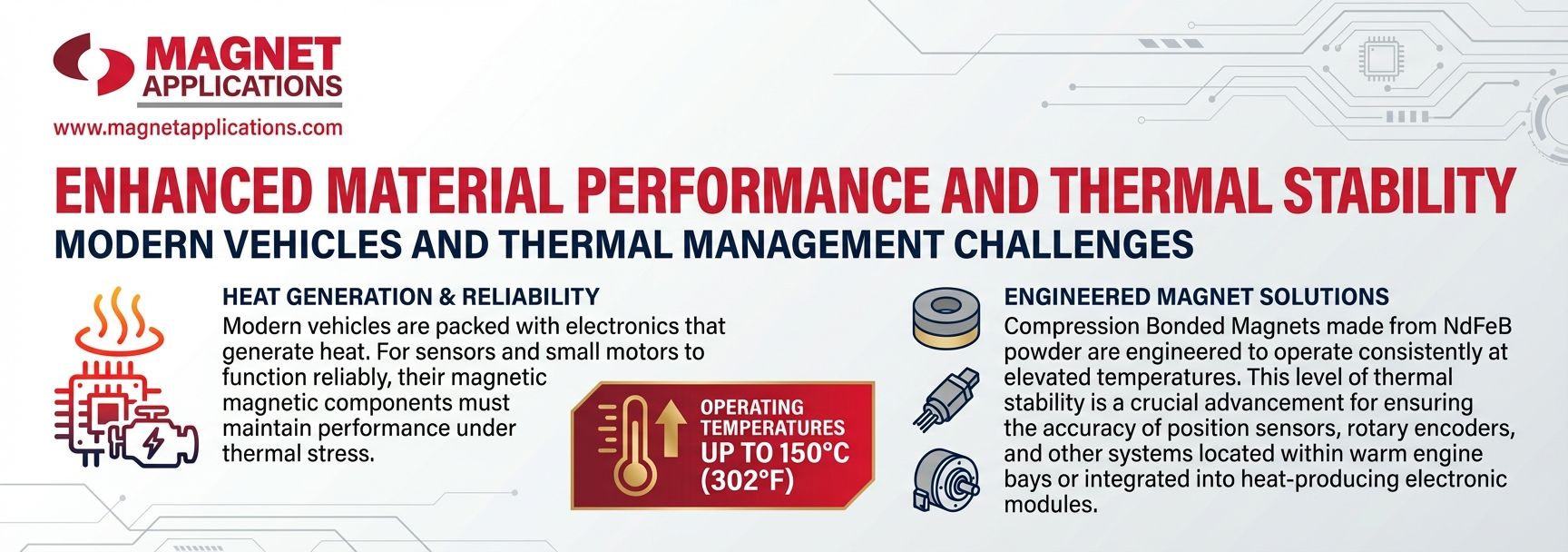
Modern vehicles are packed with electronics that generate heat. For sensors and small motors to function reliably, their magnetic components must maintain performance under thermal stress.
Compression Bonded Magnets made from NdFeB powder are engineered to operate consistently at temperatures up to 150°C (302°F). This level of thermal stability is a crucial advancement for ensuring the accuracy of position sensors, rotary encoders, and other systems located within warm engine bays or integrated into heat-producing electronic modules.
Advancement #2: Sophisticated Multi-Pole Magnetization
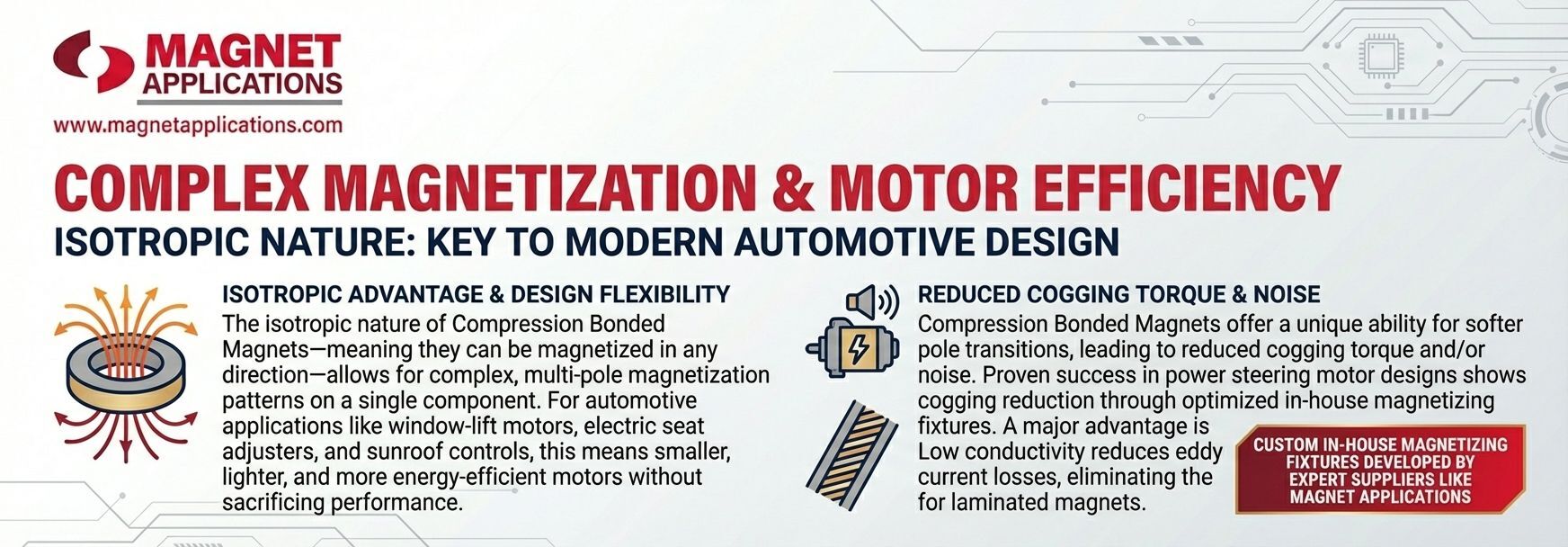
Efficiency is everything in modern automotive design. The isotropic nature of Compression Bonded Magnets—meaning they can be magnetized in any direction—is a key enabler of this efficiency.
This allows for complex, multi-pole magnetization patterns to be applied to a single magnetic ring or component. For automotive applications like window-lift motors, electric seat adjusters, and sunroof controls, this means manufacturers can design smaller, lighter, and more energy-efficient motors without sacrificing performance.
Compression Bonded Magnets also have a unique ability to offer a softer pole transition leading to reduced cogging torque and/or noise.
We have proven that using Compression Bonded Neodymium magnets on a power steering motor design, could reduce cogging by optimizing our in-house designs for the magnetizing fixture.
A major advantage of using Compression Bonded Neodymium magnets is that they can offer skewed poles, which can reduce cogging torque and noise. Of course, the low conductivity of Compression Bonded Neodymium magnets will reduce eddy current losses in rotors. As a result, there is no need for laminating magnets as many people do with Sintered Neodymium magnets.
This advancement is facilitated by expert suppliers like Magnet Applications, which develops custom magnetizing fixtures in-house to achieve these precise patterns.
Advancement #3: Precision Net-Shape Manufacturing
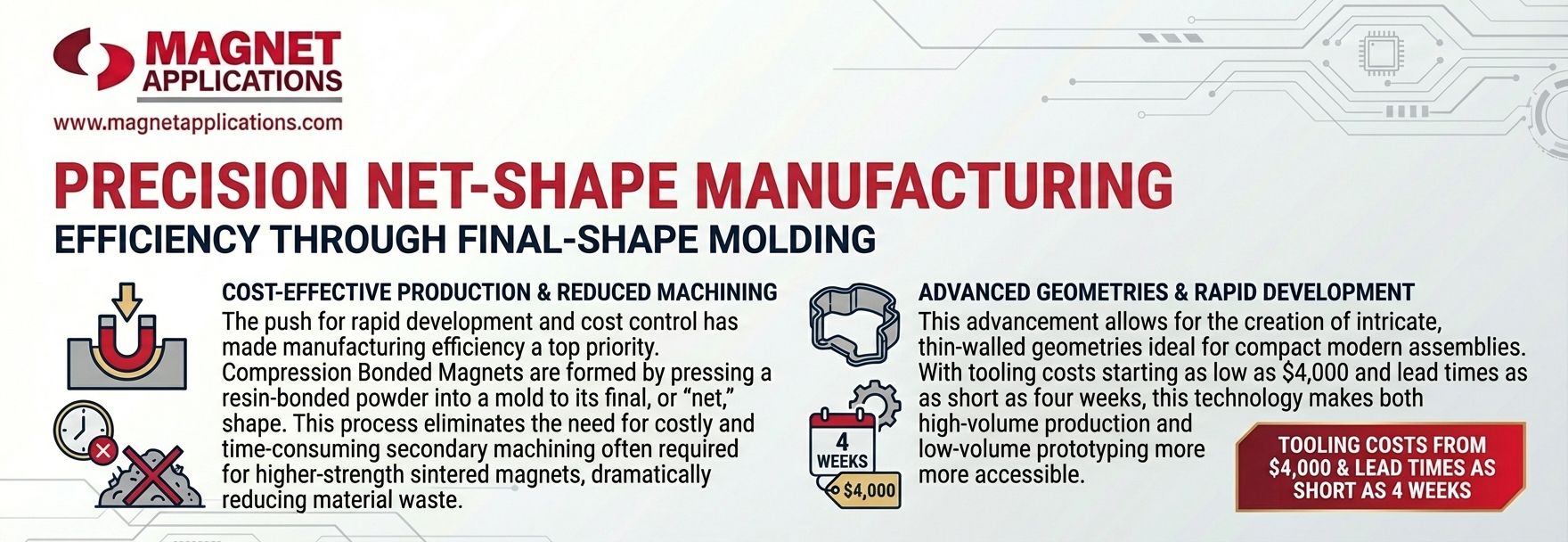
The push for rapid development and cost control has made manufacturing efficiency a top priority. Compression Bonded Magnets are formed by pressing a resin-bonded powder into a mold to its final, or "net," shape.
This process eliminates the need for costly and time-consuming secondary machining that is often required for higher-strength sintered magnets. This advancement dramatically reduces material waste and allows for the creation of intricate, thin-walled geometries ideal for compact modern assemblies. With tooling costs starting as low as $4,000 and lead times as short as four weeks, this technology makes both high-volume production and low-volume prototyping more accessible.
The Geopolitical Advancement: Securing the Automotive Supply Chain
Perhaps the most critical advancement for 2026 is not technological but logistical. Following China's halt of magnet exports to the U.S. in 2025, the ability to source critical components domestically has shifted from a preference to a necessity.
This is where a fully integrated U.S. supplier becomes a game-changer. Magnet Applications, a division of Bunting, stands as the only U.S.-based manufacturer offering a complete, end-to-end production pipeline for Compression Bonded Magnets. From powder sourcing and tooling to pressing, coating, and magnetization, every step occurs at their facility in Pennsylvania. This provides automotive OEMs with an unparalleled strategic advantage: a secure, predictable, and compliant supply chain immune to international trade volatility.
2026 Automotive Applications: Where Compression Bonded Magnets Excel
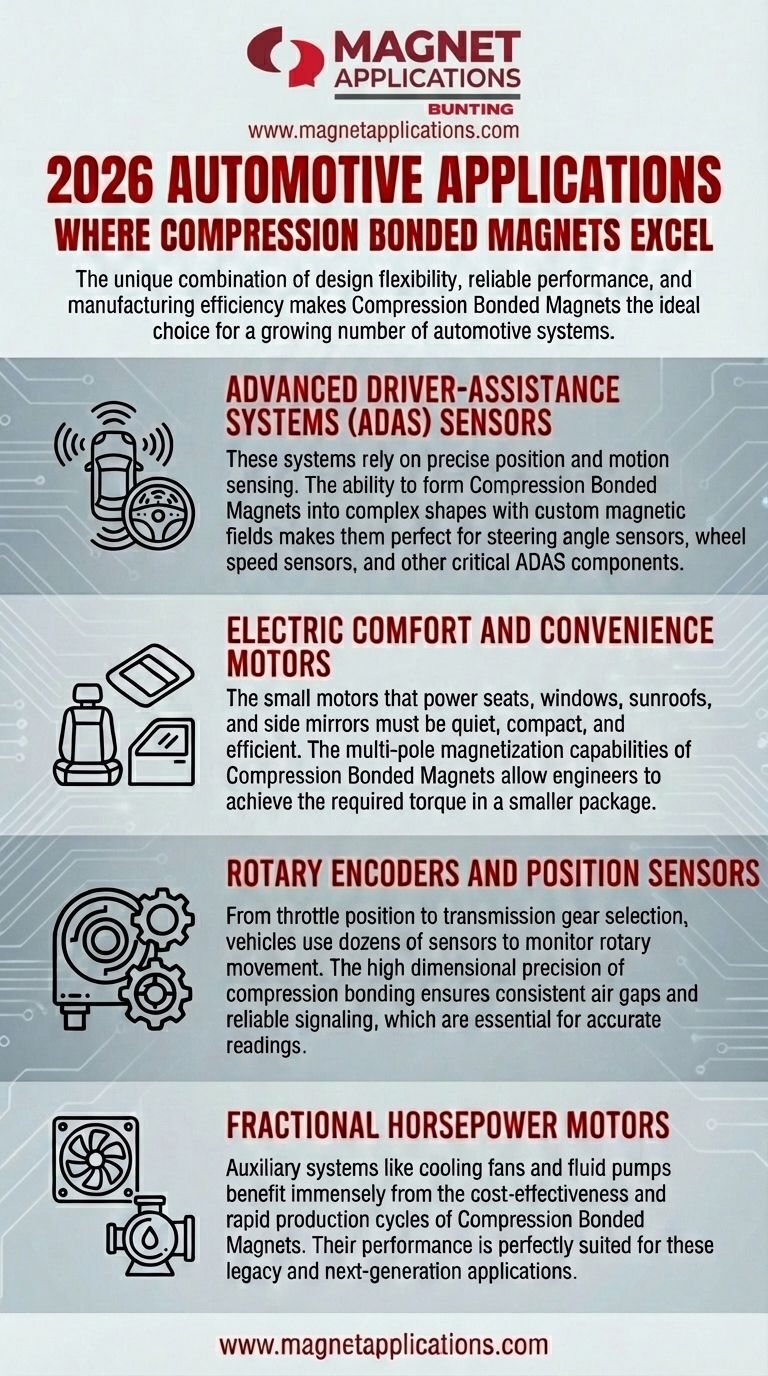
The unique combination of design flexibility, reliable performance, and manufacturing efficiency makes Compression Bonded Magnets the ideal choice for a growing number of automotive systems.
- Advanced Driver-Assistance Systems (ADAS) Sensors: These systems rely on precise position and motion sensing. The ability to form Compression Bonded Magnets into complex shapes with custom magnetic fields makes them perfect for steering angle sensors, wheel speed sensors, and other critical ADAS components.
- Electric Comfort and Convenience Motors: The small motors that power seats, windows, sunroofs, and side mirrors must be quiet, compact, and efficient. The multi-pole magnetization capabilities of Compression Bonded Magnets allow engineers to achieve the required torque in a smaller package.
- Rotary Encoders and Position Sensors: From throttle position to transmission gear selection, vehicles use dozens of sensors to monitor rotary movement. The high dimensional precision of compression bonding ensures consistent air gaps and reliable signaling, which are essential for accurate readings.
- Fractional Horsepower Motors: Auxiliary systems like cooling fans and fluid pumps benefit immensely from the cost-effectiveness and rapid production cycles of Compression Bonded Magnets. Their performance is perfectly suited for these legacy and next-generation applications.
Why Magnet Applications is the Partner for 2026 and Beyond
To leverage these advancements, automotive manufacturers need more than just a component supplier; they need a strategic partner. Magnet Applications offers a comprehensive solution built for the demands of 2026.
- 100% U.S. Supply Chain: Complete independence from Chinese rare-earth magnet suppliers, ensuring supply chain stability.
- End-to-End In-House Control: From engineering and design support to custom tooling, coating, and magnetization, they control the entire process.
- Unmatched Compliance: Fully compliant with automotive and defense standards, including ISO 9001:2015, PPAP, ITAR, and DFARS.
- Speed and Agility: With services like the MagVault™ inventory management program, they support Just-In-Time (JIT) delivery, reducing inventory costs and lead times.
In conclusion, the advancements in Compression Bonded Magnets for 2026 are a powerful blend of refined technology and strategic manufacturing. They enable engineers to build more efficient and reliable vehicles while providing OEMs with the secure, domestic supply chain necessary to compete in a complex global market.
Frequently Asked Questions
What are the key technological advancements in compression bonded magnets for 2026?
The key advancements are enhanced thermal stability up to 150°C for sensor accuracy, sophisticated multi-pole magnetization for smaller and more efficient motors, and precision net-shape manufacturing which eliminates costly secondary machining and reduces material waste.
Why is a U.S.-based supply chain for automotive magnets so critical?
A U.S.-based supply chain is critical because it provides automotive OEMs with a secure, predictable, and compliant source for essential components, making them immune to international trade volatility and supply disruptions, such as the halt of magnet exports from China.
What automotive parts use advanced compression bonded magnets?
They are used in a variety of systems, including Advanced Driver-Assistance Systems (ADAS) sensors (e.g., steering angle and wheel speed sensors), electric comfort motors for seats, windows, and sunroofs, rotary encoders for throttle and transmission sensing, and fractional horsepower motors for pumps and cooling fans.