

Compression bonded Neodymium (NdFeB) magnets offer significant cost benefits by reducing tooling expenses compared to sintered Neodymium (NdFeB) magnets. Their ability to be molded into precise, complex shapes without the need for additional machining minimizes material waste and simplifies component assembly. This directly lowers overall production costs for automotive manufacturers.
What You'll Learn
This article breaks down the key financial advantages of integrating compression bonded magnets into your automotive manufacturing process. We will explore:
- Direct Cost Reductions: How lower tooling expenses and minimal material waste translate to immediate savings.
- Assembly and Labor Savings: Why their unique "net-shape" manufacturing process simplifies integration and cuts down on labor costs.
- Design and Performance Efficiency: How isotropic properties enable simpler, more cost-effective motor and sensor designs.
- Supply Chain Stability: The critical financial benefit of a secure, domestic supply chain for essential magnetic components.
Direct Cost Savings: Tooling and Material
For any high-volume manufacturing process, the initial and ongoing costs of tooling and raw materials are primary concerns. Compression bonded magnets address both of these areas, offering a more economical path from design to production.
Lower Initial Tooling Costs
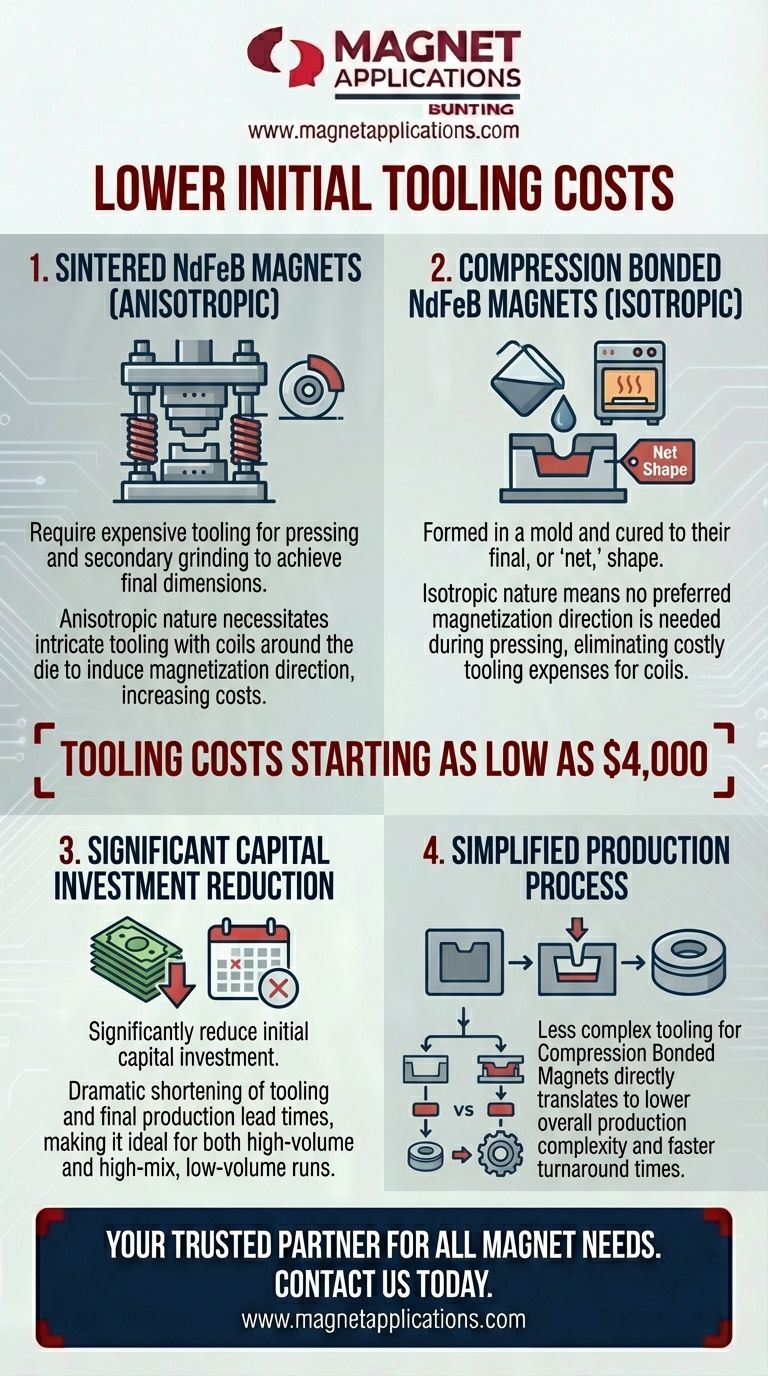
Unlike sintered Neodymium (NdFeB) magnets that often require expensive tooling for pressing and secondary grinding operations to achieve final dimensions, Compression Bonded Neodymium (NdFeB) Magnets are formed in a mold and cured to their final, or "net," shape.
This process requires less complex and therefore less expensive tooling. With tooling costs starting as low as $4,000, manufacturers can significantly reduce the initial capital investment required for a new component, making it ideal for both high-volume production and high-mix, low-volume runs. As an added bonus, tooling lead times are dramatically shortened, making final production lead times far shorter.
As we go on to explain later in this blog, sintered Neodymium (NDFEB) magnets are Anisotropic in nature and thus the tool is far more intricate and has the added cost of coils around the die to induce a direction of magnetization. Compression Bonded Neodymium (NdFeB) magnets on the other hand are Isotropic and do not need to have a preferred direction of axis or magnetization at time of pressing, thus eliminating costly tooling expenses.
Reduced Material Waste
The manufacturing process for Compression Bonded Magnets is inherently efficient. A precise mixture of NdFeB powder and a resin binder is pressed into a mold. This additive-style process means very little material is wasted. In contrast, subtractive processes like machining sintered blocks to a specific shape can result in significant material scrap, driving up the cost per part.
Indirect Cost Savings: Streamlined Assembly and Labor
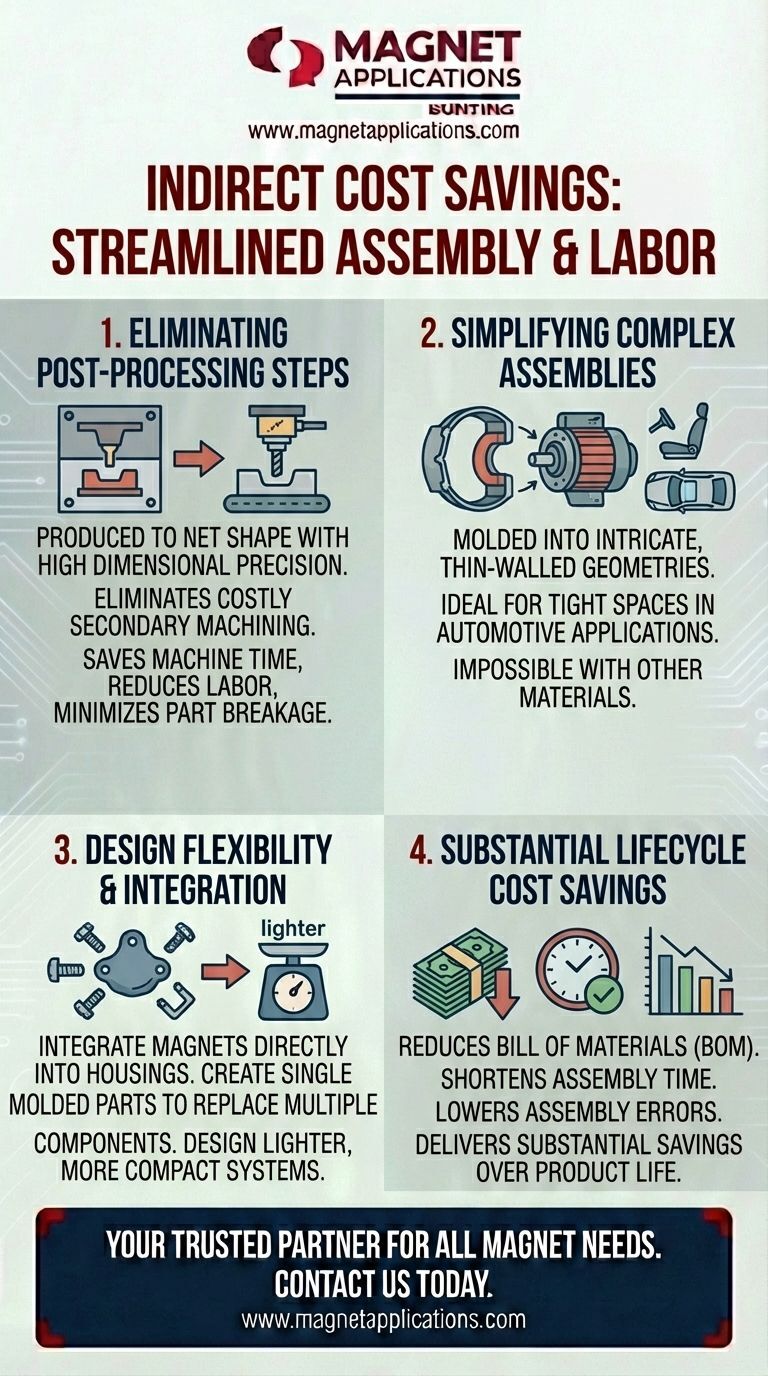
The most significant cost benefits are often found in assembly. The unique physical properties of compression bonded magnets allow for designs that radically simplify how components fit together on the production line.
Eliminating Post-Processing Steps
Because Compression Bonded Magnets are produced to net shape with high dimensional precision, they eliminate the need for costly and time-consuming secondary machining. Sintered magnets are brittle and difficult to work with, but a compression bonded part comes out of the mold ready for magnetization and assembly. This saves machine time, reduces labor, and minimizes the risk of part breakage during production.
Simplifying Complex Assemblies
Automotive applications like seat adjustment motors, sunroof controls, and window actuators operate in tight, complex spaces. Compression Bonded Magnets can be molded into intricate and thin-walled geometries that are impossible or prohibitively expensive to create with other materials.
This design flexibility allows engineers to:
- Integrate magnetic components directly into housings or other parts, reducing the need for fasteners and brackets.
- Create a single molded part that serves the function of multiple simpler components.
- Design lighter, more compact systems, contributing to overall vehicle weight reduction and fuel efficiency.
Each of these points reduces the bill of materials (BOM), shortens assembly time, and lowers the potential for assembly errors, delivering substantial cost savings over the life of the product.
Performance and Design Efficiency Gains
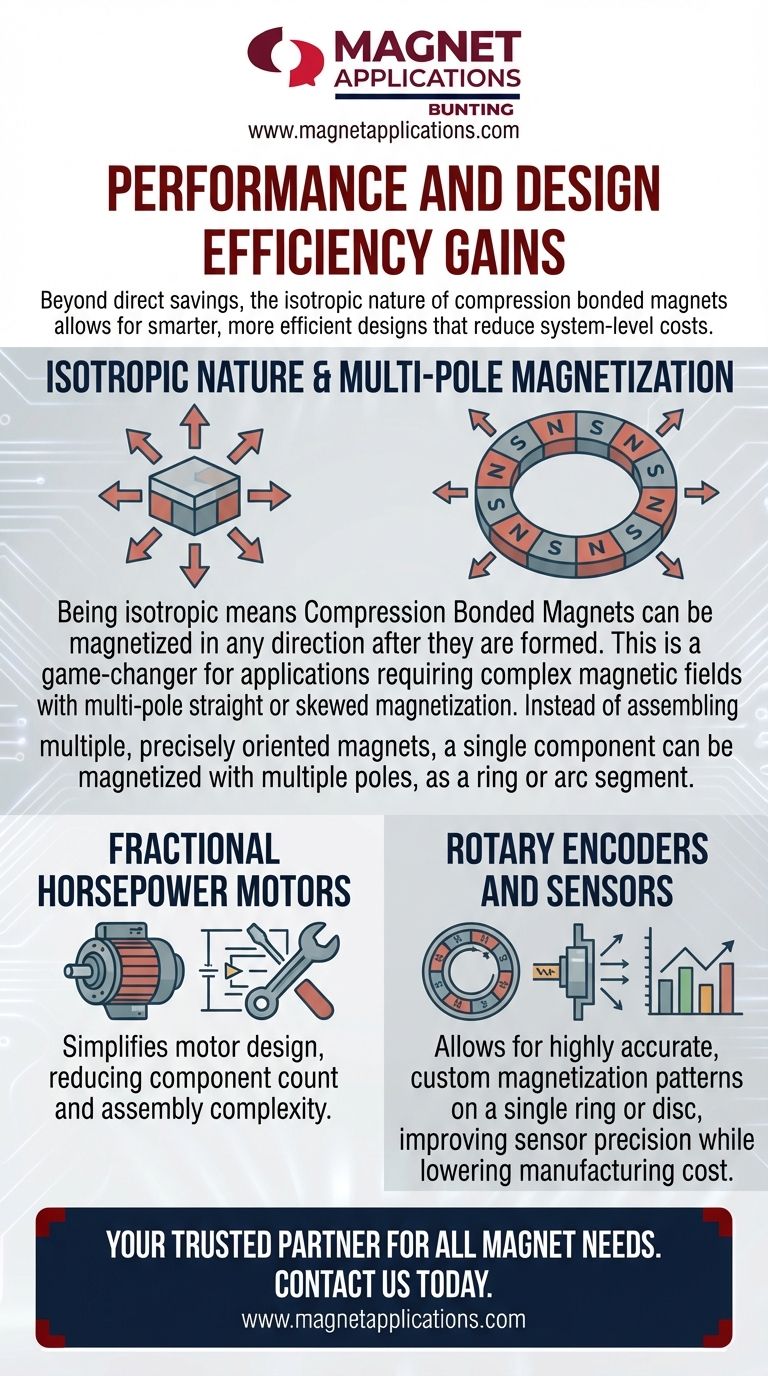
Beyond direct savings, the isotropic nature of compression bonded magnets allows for smarter, more efficient designs that reduce system-level costs.
Being isotropic means Compression Bonded Magnets can be magnetized in any direction after they are formed. This is a game-changer for applications requiring complex magnetic fields, requiring multi-pole straight or skewed magnetization Instead of assembling multiple, precisely oriented magnets, a single compression bonded component can be magnetized with multiple poles, as a ring or arc segment.
This is especially beneficial for:
- Fractional Horsepower Motors: Simplifies motor design, reducing component count and assembly complexity.
- Rotary Encoders and Sensors: Allows for highly accurate, custom magnetization patterns on a single ring or disc, improving sensor precision while lowering manufacturing cost.
Mitigating Financial Risk with a Stable Supply Chain
In today's volatile global market, supply chain instability is a major financial risk. Long lead times, tariffs, and geopolitical uncertainty can lead to production delays and unpredictable cost hikes. This is where a domestic manufacturing partner becomes a strategic financial advantage.
Magnet Applications, the only U.S.-based, full-service supplier of Compression Bonded Neodymium (NdFeB) Magnets, offers a zero-China supply chain. By controlling every step—from powder sourcing to final magnetization—at their Pennsylvania facility, they provide:
- Predictable Lead Times: With lead times as short as 4 weeks for existing tooling, manufacturers can maintain leaner inventories and respond faster to market demand. Typical lead times for new tooling is often measured in weeks, not months as with sintered Neodymium (NdFeB) magnets.
- Cost Stability: A domestic supply chain is insulated from international tariffs and shipping volatility, leading to more predictable component pricing.
- Assured Compliance: As a fully U.S.-based operation, they meet ITAR, DFARS, RoHS, and REACH standards, eliminating the risk and cost of non-compliance for sensitive automotive and defense-related projects.
By partnering with a domestic supplier like Magnet Applications with over 40 years supplying Compression bonded Neodymium (NdFeB) magnets into the US market, automotive manufacturers can transform a potential liability into a source of competitive strength and long-term cost stability.