

Injection molded magnets enhance electric motor reliability through their exceptional dimensional accuracy, uniform magnetic properties, and superior resistance to corrosion and physical shock. This unique combination reduces operational failures, minimizes performance degradation over time, and extends the motor's overall lifespan.
What You'll Learn
This article breaks down exactly how injection molded magnets contribute to more durable and dependable electric motors. Here’s a quick overview of what we’ll cover:
- Manufacturing Precision: How the injection molding process creates dimensionally perfect magnets that reduce vibration and wear.
- Material Consistency: Why the homogenous blend of magnetic powder and polymer binder delivers a predictable and stable magnetic field.
- Enhanced Durability: How these magnets resist common failure points like corrosion, moisture, and physical impact.
- Design Flexibility: How complex shapes and integrated designs lead to simpler, more robust motor assemblies with fewer points of failure.
The Foundation of Reliability: Manufacturing and Material Composition
The exceptional reliability of motors using injection molded magnets isn't accidental; it's a direct result of their unique manufacturing process and material composition. Unlike traditional sintered magnets, which are brittle and prone to chipping, injection molded magnets combine magnetic powders with durable polymer binders.
Uniform Magnetic Properties for Consistent Performance
The process begins by mixing magnetic powders, such as neodymium-iron-boron (NdFeB) or ferrite, with a polymer binder like nylon. This creates a highly consistent, homogenous mixture that is then injected into a precision mold.
This uniformity is critical for reliability. It ensures a predictable and evenly distributed magnetic field across the entire magnet. This eliminates the magnetic "hot spots" or weak points that can cause torque ripple, inefficiency, and eventual performance degradation in a motor.
Unmatched Dimensional Accuracy
The injection molding process allows for the creation of magnets with extremely tight tolerances and precise dimensions. For an electric motor, this accuracy is paramount.
- Perfect Fit: A precise fit ensures a consistent air gap between the motor's rotor and stator, which is crucial for efficient and stable operation.
- Reduced Vibration: Inconsistent dimensions can lead to imbalance and vibration, which causes premature wear on bearings and other mechanical components. Injection molded magnets mitigate this risk by ensuring every component is dimensionally identical.
Key Benefits of Injection Molded Magnets for Motor Reliability
The inherent properties of these magnets directly address the most common causes of electric motor failure.
Complex Geometries and Integrated Design
The fluidity of the molding process allows injection molded magnets to be formed into highly complex and intricate shapes. This enables engineers to design motors with multi-pole magnetization patterns in a single component. By integrating features like shafts or gears directly into the magnet, you reduce the total number of parts in an assembly. Fewer parts mean fewer potential points of failure, a simpler assembly process, and a more robust final product.
Superior Resistance to Environmental Factors
The polymer binder does more than just hold the magnetic particles together; it encapsulates and protects them. This provides two key reliability advantages:
- Corrosion Resistance: The polymer shield prevents moisture and oxygen from reaching the magnetic material, offering excellent protection against rust and corrosion—a major cause of failure in harsh environments.
- Shock and Vibration Dampening: The polymer base gives the magnet inherent resistance to physical shock and vibration. This makes motors with injection molded magnets far more durable in applications with high mechanical stress, such as automotive systems or industrial machinery.
Lightweight Construction Reduces Mechanical Stress
Because a significant portion of their volume is a lightweight polymer, injection molded magnets are less dense than fully metallic sintered magnets. This reduction in mass lowers the motor's rotational inertia. The result is less mechanical stress on shafts and bearings during start-up and operation, leading to a longer and more reliable service life.
Applications: Where Reliability Matters Most
The enhanced reliability offered by injection molded magnets makes them the ideal choice for applications where failure is not an option.
Automotive Micromotors and Actuators
In the automotive sector, small motors power everything from automated vents and mirrors to critical position sensors. A failure in these components can impact vehicle safety and quality. Injection molded magnets are perfectly suited for these low-power rotational systems because their consistency, light weight, and resistance to vibration ensure they function flawlessly for the entire life of the vehicle.
Precision Control Systems
For actuators and micromotors used in robotics, medical devices, and aerospace, precise and repeatable performance is essential. The dimensional stability and uniform magnetic field of injection molded magnets prevent performance drift over millions of cycles, ensuring these systems operate with unwavering accuracy and reliability.
The Clear Choice for Dependable Motor Performance
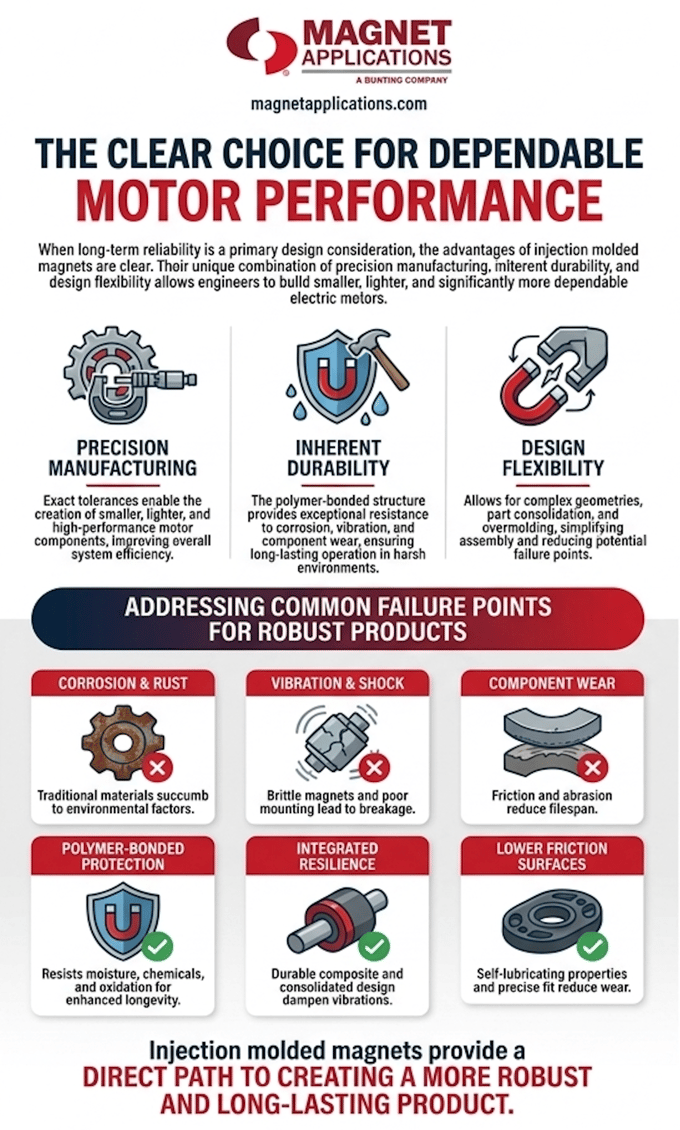
When long-term reliability is a primary design consideration, the advantages of injection molded magnets are clear. Their unique combination of precision manufacturing, inherent durability, and design flexibility allows engineers to build smaller, lighter, and significantly more dependable electric motors. By addressing common failure points like corrosion, vibration, and component wear, injection molded magnets provide a direct path to creating a more robust and long-lasting product.
Frequently Asked Questions
How do injection molded magnets improve electric motor reliability?
Injection molded magnets boost motor reliability through a combination of exceptional dimensional accuracy, which reduces vibration and wear; uniform magnetic properties for consistent performance; superior resistance to corrosion and physical shock; and design flexibility that allows for simpler assemblies with fewer points of failure.
What makes injection molded magnets more durable than traditional magnets?
Their durability comes from the polymer binder that encapsulates the magnetic particles. This protective layer provides excellent resistance to rust and corrosion by shielding the material from moisture and oxygen. The polymer base also gives the magnet inherent resistance to physical shock and vibration.
Why is the manufacturing process of injection molded magnets critical for reliability?
The injection molding process is critical because it creates magnets with extremely precise dimensions and tight tolerances. This ensures a perfect fit within the motor, a consistent air gap, and reduced vibration, which prevents premature wear on bearings and other mechanical components. The process also ensures a homogenous blend of materials for a stable and predictable magnetic field.